
On 26 February 2026, the Council of Ministers approved the National Strategy for Persons with Disabilities, prepared by the Ministry of Social Affairs with the participation of organizations of persons with disabilities, partner organizations, and all relevant ministries. The strategy was developed through technical cooperation with the United Nations Population Fund (UNFPA) and the United Nations Economic and Social Commission for Western Asia (ESCWA), leading to the preparation of the National Strategy for the Rights and Inclusion of Persons with Disabilities in Lebanon (2026–2030).
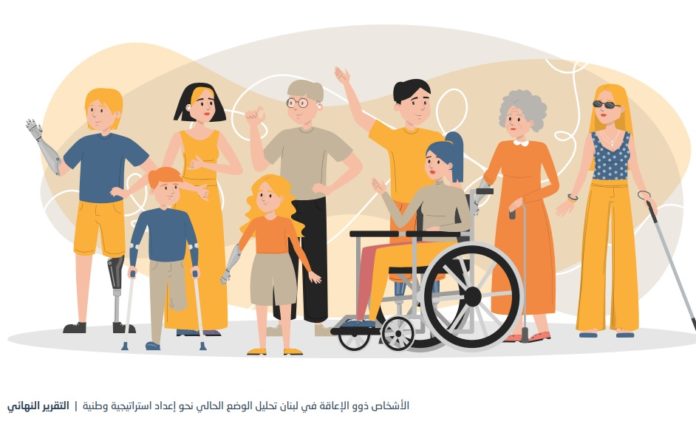
Persons with disabilities, like other Lebanese citizens, face multiple crises resulting from the financial and economic collapse that has affected Lebanon in recent years, in addition to the long-standing challenges they already faced due to marginalization, exclusion, discrimination, and inequality across all areas of social, economic, and educational life. At the same time, persons with disabilities represent approximately 10% of Lebanon’s total population, with the World Health Organization estimating their number at more than 400,000 individuals.
According to the Ministry of Social Affairs, around 120,000 of them had obtained a personal disability card as of early 2023, in addition to many others who do not hold such cards.
Against this backdrop, Lebanon’s ratification of the Convention on the Rights of Persons with Disabilities provided a broad human rights and humanitarian framework for this strategy, making it both a guiding and binding instrument for implementing the Convention and a roadmap for transforming and improving the unacceptable reality experienced by persons with disabilities in Lebanon.
Notably, several signs of change have begun to emerge in the disability sector over the past three years, despite the bleak national context. The Ministry of Social Affairs has started to seriously explore funding opportunities to improve and modernize the disability card system, reassess and classify disabilities in Lebanon, while parliamentary committees and organizations of persons with disabilities have begun preparing legal drafts to amend and update national legislation and adopt new laws consistent with the Convention. United Nations agencies have also become increasingly engaged in disability-related initiatives and have provided support to stakeholders working in the disability field, particularly organizations of persons with disabilities. In addition, and at the initiative of the Ministry of Social Affairs, UNICEF and the International Labour Organization, together with a large number of organizations, prepared and developed a national social protection strategy, which was approved by the government under Cabinet Decision No. 5/23 issued on 1 November 2023.
This strategy takes into account most disability-related needs. Finally, the positive developments of this period were crowned by a strategic partnership established between the International Labour Organization and UNICEF, on the one hand, and eight associations representing persons with disabilities in Lebanon on the other. This partnership represents the first of its kind between United Nations agencies and organizations of persons with disabilities, as well as the first joint initiative undertaken collectively by these organizations, which in itself constitutes a significant step forward compared to the previous reality.
Hence, the urgent need for a national disability strategy capable of bringing about change based on a strategic vision, a set of clear objectives, and a realistic framework for implementation in phases. The strategy also aims to establish an inclusive society for all, grounded in justice, equality, and non-discrimination. Over the course of its eight-year implementation period, it seeks to mainstream disability inclusion across projects and programmes, and to ensure that services and public spaces become inclusive and accessible to persons with disabilities. By adopting the Convention on the Rights of Persons with Disabilities as a guiding and binding framework, the strategy embraces all of its principles and places the implementation of inclusion policies at the forefront of priorities across all sectors of economic, health, social, educational, and political life. These changes will be reflected through the modernization and amendment of legislation to ensure its alignment with the provisions of the Convention on the Rights of Persons with Disabilities.
هذه المقالة متاحة أيضًا بـ:

