
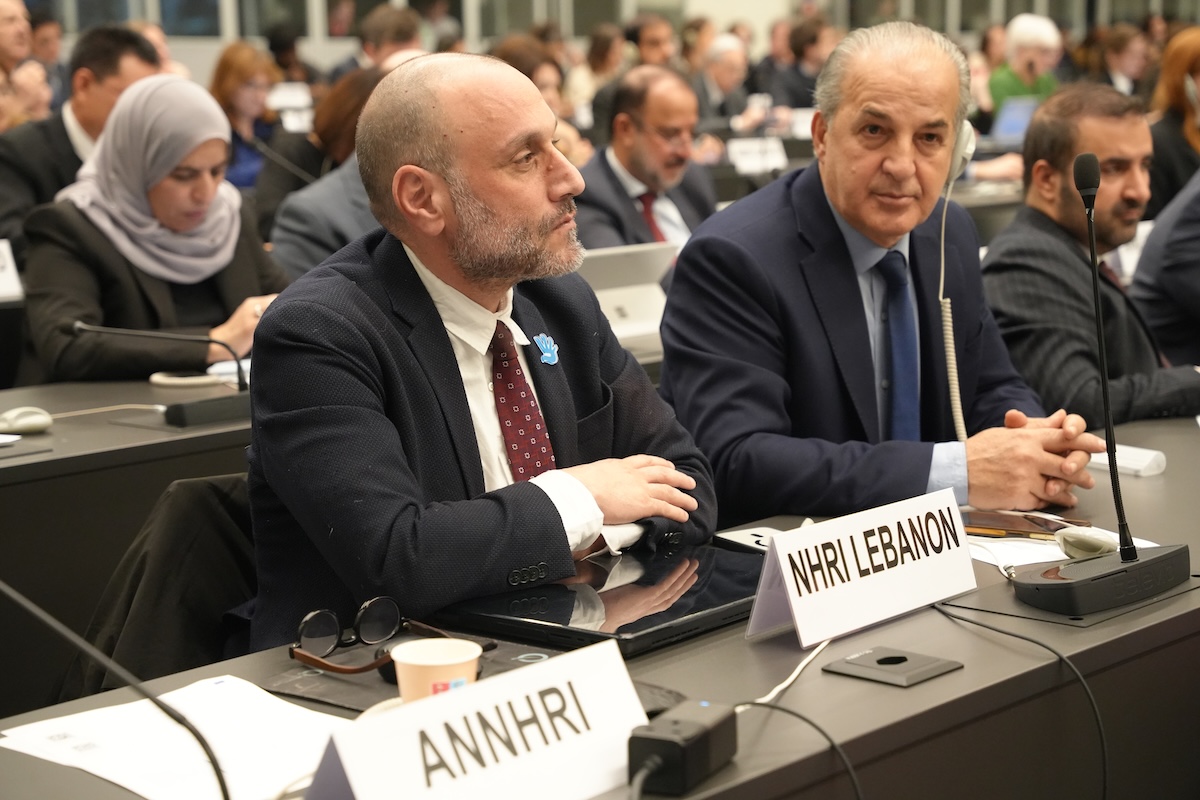
The National Human Rights Commission of Lebanon, including the Committee for the Prevention of Torture (NHRC-CPT), actively participated in the Global Alliance of National Human Rights Institutions (GANHRI) 2026 Annual Conference, held at the Palais des Nations in Geneva. The conference, convened under the theme “The Role of National Human Rights Institutions in Promoting and Protecting Human Rights in the Digital Space,” brought together national institutions, international organizations, and experts from across all regions to address the growing intersection between digital technologies and human rights.
The Lebanese delegation was led by Dr. Fadi Gerges, President of the NHRC-CPT, and Mr. Bassam Al Kantar, Commissioner for International Relations. Their participation comes at a critical time, as Lebanon continues to face escalating humanitarian challenges and complex human rights concerns, including those linked to digitalization in conflict contexts.
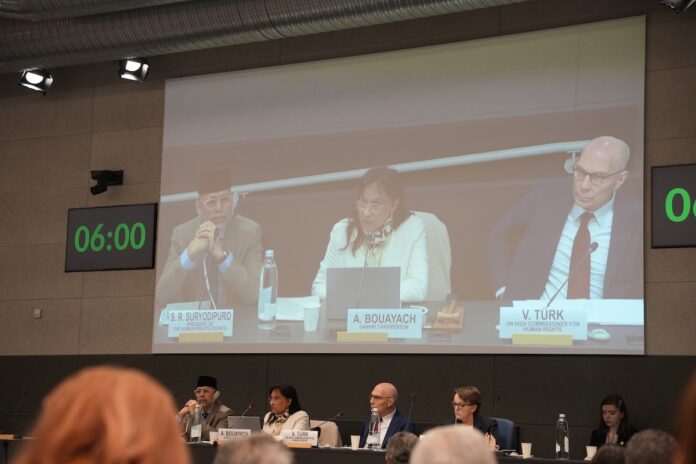
The conference opened with high-level remarks from prominent international figures, including Ms. Amina Bouayach, Chairperson of GANHRI, Mr. Volker Türk, United Nations High Commissioner for Human Rights, and Ambassador Sidharto Reza Suryodipuro, President of the Human Rights Council. Discussions throughout the day explored the role of national institutions in addressing emerging risks associated with digital technologies, including artificial intelligence, surveillance, and data governance.
In its engagement, the NHRC-CPT emphasized the urgent need to anchor digital transformation within a robust human rights framework, particularly in fragile and conflict-affected settings. The delegation highlighted recent developments in Lebanon, where digital tools have increasingly intersected with humanitarian realities, including the use of digital platforms in the dissemination of evacuation warnings and the broader implications of technology on civilian protection.
The conference provided a platform for in-depth discussions on regulatory frameworks, oversight mechanisms, and accountability in the digital sphere. Participants examined how national human rights institutions can contribute to legislative processes, monitor emerging technologies, and ensure that innovation does not outpace the development of adequate safeguards.
A key outcome of the conference was the adoption of a comprehensive outcome statement reaffirming that international human rights law applies fully in digital environments and that the same rights enjoyed offline must be protected online. The statement underscored growing concerns regarding unlawful surveillance, misuse of personal data, algorithmic discrimination, and the use of digital technologies to intimidate or silence human rights defenders.
The NHRC-CPT welcomed the outcome statement and reiterated its commitment to strengthening its role in monitoring and addressing human rights implications of digital technologies at the national level. The Commission stressed the importance of ensuring that digital systems, including artificial intelligence, are governed by principles of legality, necessity, proportionality, transparency, and accountability.
The Lebanese delegation also highlighted the need to bridge digital divides and ensure equitable access to digital infrastructure and services. In contexts such as Lebanon, where economic and humanitarian crises have strained public systems, unequal access to digital tools risks further marginalizing vulnerable populations and limiting their access to essential services and remedies.
Furthermore, the NHRC-CPT underscored the importance of safeguarding civic space in digital environments. The Commission expressed concern over the increasing use of digital tools to restrict freedom of expression, monitor civil society actors, and undermine democratic participation. It called for strengthened protections for journalists, human rights defenders, and vulnerable groups who are disproportionately exposed to digital harms.
The conference also highlighted the role of NHRIs in enhancing public awareness and digital literacy. The NHRC-CPT reaffirmed its commitment to promoting a rights-based approach to digital transformation through education, advocacy, and engagement with stakeholders, including government authorities, civil society, and international partners.
On the margins of the conference, the NHRC-CPT delegation engaged in bilateral meetings with international counterparts and United Nations representatives to explore opportunities for cooperation and capacity-building. These discussions focused on strengthening institutional responses to emerging human rights challenges, including those related to artificial intelligence, digital governance, and the protection of fundamental freedoms in online spaces.
The NHRC-CPT emphasized that as digital technologies continue to evolve and reshape societies, national human rights institutions must remain at the forefront of ensuring that these developments serve people and uphold human dignity. The Commission reaffirmed its commitment to contributing to international efforts aimed at promoting human rights–based digital governance and to ensuring that no one is left behind in the digital age.
The participation of the NHRC-CPT in the GANHRI 2026 Annual Conference reflects Lebanon’s continued engagement in global human rights processes and its commitment to addressing emerging challenges at the intersection of technology and human rights.
هذه المقالة متاحة أيضًا بـ:

