
By Fadi Gerges – President of NHRC-CPT
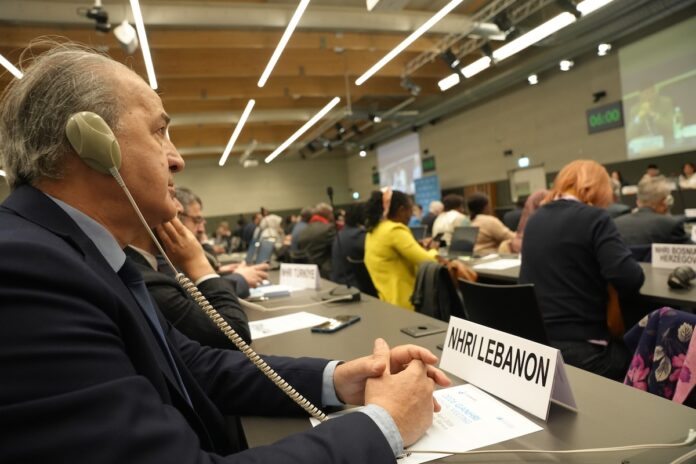
In the corridors of the Palais des Nations, where diplomacy often moves at the pace of protocol, something more urgent is unfolding. Representatives of national human rights institutions from across the world have gathered not just to exchange statements, but to confront a shared reality, the rules that once governed the protection of rights are being tested, stretched, and in some cases, quietly rewritten.
For the National Human Rights Commission of Lebanon, including the Committee for the Prevention of Torture (NHRC-CPT), being here is not ceremonial. It is strategic.
This year’s annual meeting of the Global Alliance of National Human Rights Institutions, GANHRI, focuses on a theme that might sound technical at first glance, digital space and human rights. But behind the language lies a profound shift. Increasingly, rights are no longer only violated in prisons, courtrooms, or streets. They are shaped, restricted, and sometimes erased through algorithms, surveillance systems, and online environments that remain largely unregulated.
The conference documents make this clear, digital systems now mediate access to public services, participation in civic life, and even justice itself, while at the same time enabling new forms of surveillance, profiling, and control .
For a country like Lebanon, this conversation is anything but abstract.
A country in crisis, a commission under pressure
Back home, the NHRC-CPT operates in a landscape defined by overlapping crises, economic collapse, institutional fragility, and renewed conflict dynamics. Its work ranges from monitoring detention conditions to documenting violations and advocating for accountability. It is work that is often constrained by access, resources, and political realities.
And yet, it is precisely this context that makes participation in Geneva essential.
Because the issues discussed here, surveillance, digital governance, accountability mechanisms, are not separate from Lebanon’s challenges. They are embedded within them. Decisions about technology, data, and control are increasingly tied to security policies, public administration, and even humanitarian responses.
The risk, as highlighted in the draft outcome of the conference, is that digitalisation advances faster than safeguards, allowing harmful practices to become normalized before they are properly understood or regulated .
For institutions working on the ground, that gap can translate into real harm, invisible, systemic, and difficult to challenge.
More than attendance, a question of influence
There is a tendency to view international meetings as symbolic, a space for formal speeches and carefully worded communiqués. But inside the sessions, the dynamics are more complex.
The agenda reflects a deliberate shift toward practical engagement, discussions on regulating artificial intelligence, ensuring oversight, protecting rights online, and strengthening accountability mechanisms .
What matters here is not only what is said, but what is shaped.
Outcome statements adopted in these forums often inform UN processes, influence donor priorities, and set the tone for national-level reforms. For smaller or crisis-affected countries, participation becomes a way to ensure their realities are not sidelined.
For the NHRC-CPT, being active in this space means bringing Lebanon into the conversation, not as a passive recipient of international standards, but as a contributor with lived experience.
It also means something more subtle, resisting the marginalization that often accompanies crisis contexts.
The digital shift, and why it matters now
If there is one thread running through this year’s discussions, it is the recognition that the nature of human rights work is changing.
The threats are no longer confined to physical spaces. They extend into digital ecosystems where decisions are automated, data is extracted, and accountability is often diffuse.
The risks identified are wide-ranging, from unlawful surveillance and misuse of personal data to algorithmic discrimination and online harassment .
But there is also opportunity.
Digital tools can enhance monitoring, expand access to information, and strengthen engagement with communities. For institutions like the NHRC-CPT, which often operate under resource constraints, this dual reality presents both a challenge and a possibility.
The question is no longer whether to engage with digital transformation, but how to do so without compromising rights.
A space for solidarity
Beyond the technical discussions, there is another dimension to gatherings like this, one that is less visible but equally important.
Solidarity.
Across regions, national human rights institutions are facing similar pressures, shrinking civic space, political interference, resource limitations, and growing public distrust. The Geneva meeting becomes a space where these challenges are acknowledged, shared, and, to some extent, collectively addressed.
It is also a reminder that no institution operates in isolation.
The global human rights system itself is under strain, as the conference acknowledges, and maintaining its relevance requires active engagement, not withdrawal .
For the NHRC-CPT, participation is therefore not only about influence, but about connection.
What comes after Geneva
The real test, however, lies beyond the conference rooms.
What matters is what travels back.
Will the discussions translate into stronger monitoring tools, better documentation practices, more effective advocacy? Will the partnerships formed here lead to tangible support, technical, financial, or political?
And perhaps most importantly, will this engagement help bridge the persistent gap between international standards and national realities?
For the NHRC-CPT, these are not rhetorical questions. They define the value of participation.
Being present, being relevant
In the end, being active in global platforms like GANHRI is not about visibility for its own sake.
It is about relevance.
In a rapidly changing human rights landscape, institutions must adapt, engage, and assert their role. Absence risks marginalization. Passive presence risks irrelevance.
Active participation, on the other hand, creates space, to influence, to learn, and to defend.
From Geneva to Beirut, the challenge remains the same, ensuring that human rights are not only discussed, but protected.
And that requires being at the table, and knowing why it matters.
هذه المقالة متاحة أيضًا بـ:

