
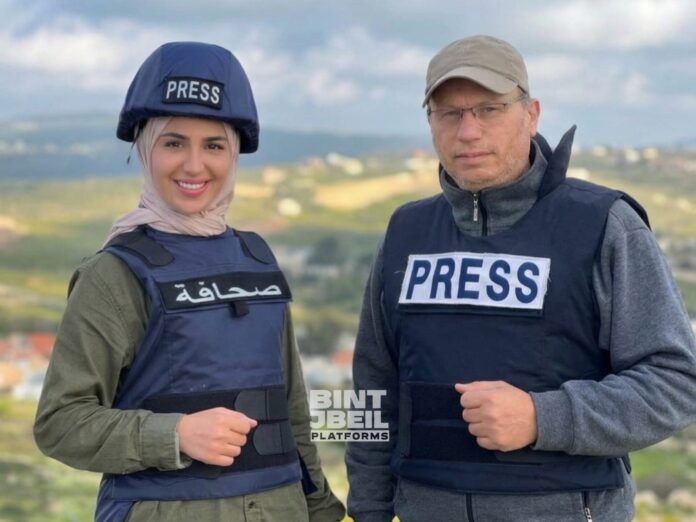
The National Human Rights Commission, including the Committee for the Prevention of Torture, has initiated forensic documentation procedures concerning the killing of journalists Ali Shoaib, Fatima Ftouni, and Mohammad Ftouni by Israeli occupation forces before noon today on the Jezzine road. The Commission extends its deepest condolences to the victims’ families, colleagues, and peers, noting that stripping journalists of their civilian status or labeling them as terrorists to justify targeting them constitutes a continuation of the policy of genocide pursued by the Israeli occupation in Gaza, which has claimed the lives of hundreds of journalists under similar pretexts.
Journalists are protected as civilians under international humanitarian law, and deliberately targeting or killing them constitutes a war crime. The Commission stresses that the United Nations must play an effective role in halting violations of international human rights law and international humanitarian law and in ensuring accountability.
The Commission further emphasized that statements of condemnation and denunciation, as well as the referral of reports on the targeting and killing of journalists, paramedics, and medical personnel to the United Nations, and recourse to complaints and protests before the United Nations Security Council, despite their importance, do not deliver justice to victims, but rather contribute to entrenching impunity for perpetrators of war crimes.
The Commission added that responding to this massacre against journalists requires convening an emergency meeting of the Council of Ministers and adopting a unanimous decision to mandate the Ministry of Foreign Affairs and Emigrants, pursuant to Article 12(3) of the Rome Statute of the International Criminal Court, to submit a declaration to the Registrar of the International Criminal Court accepting its jurisdiction over the investigation and prosecution of all crimes committed on Lebanese territory since 7 October 2023 that fall within its jurisdiction, including crimes committed against journalists, paramedics, and civil defense volunteers, with the Lebanese government committing to full cooperation with the Court in accordance with Chapter IX of the Statute.
The Commission also noted that the Lebanese government had previously adopted a similar decision on 24 April 2024, following the deliberate killing of journalist Issam Abdallah while performing his professional duties on 13 October 2023. However, the government later reversed this decision without providing any justification or explanation for such a reversal, which the Commission considers suspicious and unacceptable.
Article 12 of the Rome Statute provides that the Court may exercise its jurisdiction if the State on whose territory the conduct in question occurred is a party to the Statute or has accepted the Court’s jurisdiction. In the case of a non-State Party, it may, by declaration lodged with the Registrar, accept the Court’s jurisdiction over the crimes concerned and cooperate with the Court without delay or exception.
The Commission renews its call to the United Nations High Commissioner for Human Rights, Volker Türk, in light of his responsibility to promote and protect human rights, and to the Director-General of UNESCO, Audrey Azoulay, in light of her role in advancing the safety of journalists and combating impunity, to demand the establishment of an independent international investigation into the targeting of journalists in Lebanon.
This call builds on previous demands issued by the Commission, alongside more than 120 local and international entities, following the killing of Reuters videographer Issam Abdallah, Al Mayadeen correspondent Farah Omar, Al Mayadeen cameraman Rabih Al-Maamari, field coordinator Hussein Aqil, as well as Wissam Qassem, Ghassan Al-Najjar, and Mohammad Reda. These incidents form part of no fewer than 12 direct attacks carried out by Israel against journalists in Lebanon, which have also resulted in severe injuries to a number of journalists, including Carmen Joukhadar and Elie Berkhia (Al Jazeera), Christina Assi and Dylan Collins (AFP), and Maher Nazeh and Thaer Al-Sudani (Reuters).
Prior to the escalation of the conflict in early March 2026, southern Lebanon witnessed a marked increase in the targeting of journalists, including the use of drones and live fire by Israeli forces, as part of a recurring pattern of intimidation and attacks against media workers without accountability.
In this context, on 16 September 2025, journalist Hussein Shaaban of Legal Agenda, along with a local coordinator, was targeted by a projectile dropped from an Israeli drone, which exploded just meters away from them while they were carrying out journalistic work in a destroyed residential neighborhood in the northeastern outskirts of the border village of Al-Zalloutiyeh, Tyre district.
On 19 December 2025, an Israeli drone approached a media team from Al-Alam TV, including journalist Zeinab Faraj, while they were covering events in the Lebanese town of Kfarkela near the border, despite the team being clearly identified as press and marked with the word “Press.”
On 25 December 2025, a media team from Al Mayadeen TV was subjected to live fire by Israeli forces while covering Israeli presence in the areas of Al-Dhahira and Al-Jardah in southern Lebanon.
On 28 December 2025, independent journalist Courtney Bono, collaborating with the platform Focal Politics, and photographer Ali Ezzedine were directly threatened by Israeli soldiers using loudspeakers while covering events near the border town of Houla, despite holding the necessary permits from the United Nations Interim Force in Lebanon (UNIFIL) and relevant authorities, and being clearly identified as journalists.
This pattern of targeting continued into 2026. On 26 January 2026, an Israeli drone targeted Al-Manar TV journalist Ali Noureddine while he was inside his vehicle in a crowded area of the city of Tyre, resulting in his death.
With the escalation of military operations, on 2 March 2026, Israeli forces targeted the headquarters of Al-Manar TV, Al-Nour Radio, and Voice of Joy Radio, leading to the destruction of several buildings, in deliberate attacks on media facilities that constitute war crimes under international humanitarian law.
On 18 March 2026, Israeli forces deliberately killed journalist Mohammad Sherri, Director of Political Programs at Al-Manar TV, along with his wife, in an airstrike that targeted a residential building in the Zoqaq al-Blat area of Beirut. Their children and grandchildren, including minors, were seriously injured. Sherri joins dozens of journalists who have been killed in Lebanon, directly or indirectly, since the beginning of the hostilities on 8 October 2023, as well as hundreds of civilians who continue to be killed daily in a context of total impunity.
The following day, 19 March 2026, Israeli forces targeted a Russia Today TV crew composed of correspondent Steve Sweeney and cameraman Ali Reza Sbaiti while they were performing their journalistic duties near the Qasmiyeh bridge, which had been bombed twice the previous day. Both journalists were transferred to Jabal Amel Hospital, where they are receiving medical care.
هذه المقالة متاحة أيضًا بـ:

