
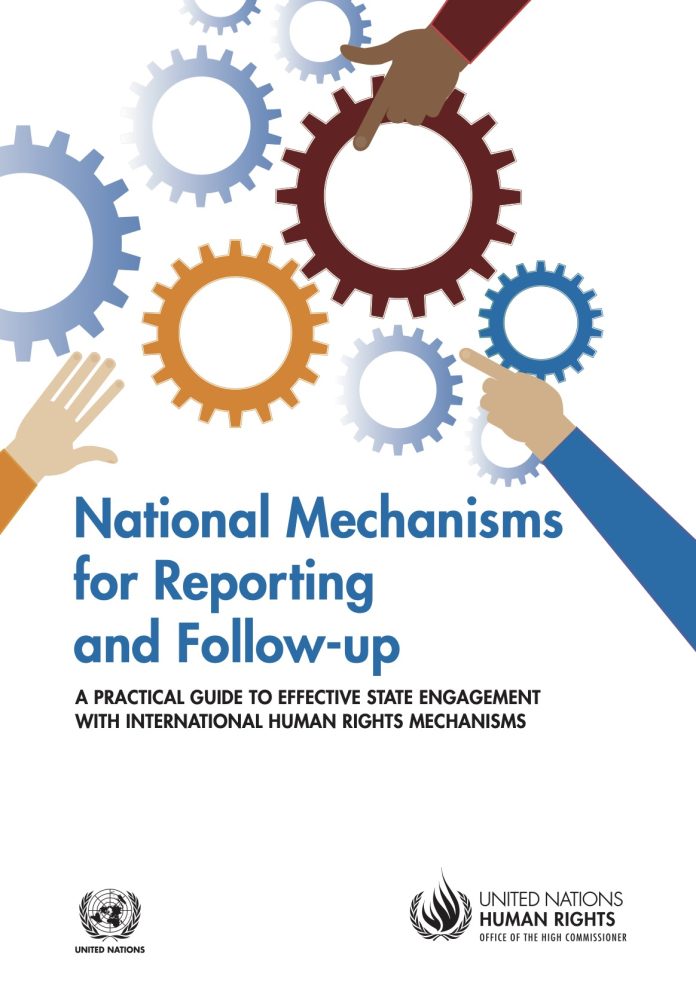
This Practical Guide and the accompanying Study of State Engagement with International Human Rights Mechanisms seek to identify key ingredients for a well-functioning and efficient national mechanism for reporting and followup, drawing on different State practices, while not proposing a one-size-fitsall solution. The Guide provides practical advice on the critical elements that States need to consider when establishing or strengthening their national mechanism for reporting and follow-up, and illustrates this advice with examples of State practice. It is based on the more comprehensive Study of State Engagement with International Human Rights Mechanisms (HR/PUB/16/1/Add.1), which contains more detailed information on these practices.
Pledges in the framework of the seventy-fifth anniversary of the Universal Declaration of Human Rights
The Human Rights 75 Initiative, which was launched in December 2022, had three main objectives: promoting the universality and indivisibility of human rights; looking to the future; and bolstering the human rights ecosystem. Pledges were encouraged to bring about concrete change towards the greater enjoyment of human rights for all. Some States formulated pledges related to the establishment and strengthening of national mechanisms. OHCHR and other stakeholders committed to work with States to help them transform pledges into a reality.
Networks of national mechanisms
Efforts to foster experience-sharing have led to several initiatives around networks of national human rights focal points or national mechanisms for implementation, reporting and follow-up.
In 2023, a network of human rights focal points for Portuguese-speaking countries, was established during the Ordinary Meeting of the Council of Ministers of the Community of Portuguese-Speaking Countries in São Tomé and Príncipe. The first meeting of the Network was held in June 2024. In 2023 and 2024, initiatives in the Caribbean and the Pacific led to an agreement to consider the creation of regional networks. At the global level, the international network of national mechanisms for implementation, reporting and follow-up was officially launched through the “Asuncion Declaration” on 9 May 2024, adopted during a meeting organized by Paraguay, attended by a total of 83 participants, including State representatives. The creation of the International Network was the result of a joint pledge by Morocco, Paraguay and Portugal.
The Marrakech Guidance Framework
As a continuation of previous endeavours, the 10th Glion Human Rights Dialogue co-organized by the Kingdom of Morocco and the Universal Rights Group in Marrakech in October 2024 led to the adoption of the Marrakech Guidance Framework (MGF), a guidance document based on international good practices and a reference tool to assist States in establishing and reinforcing effective National Mechanisms for Implementation, Reporting and Follow-up.
Background
One of the important developments in the field of human rights is the emergence of National Mechanisms for Implementation, Reporting and Follow-up (NMIRFs). These are government structures mandated to coordinate and prepare reports to, and engage with, international and regional human rights mechanisms, including the UN Treaty Bodies, the Universal Periodic Review (UPR) and Special Procedures. They also address the implementation gap by initiating, coordinating and tracking national follow-up and implementation of obligations and recommendations emanating from these mechanisms.
The establishment of NMIRFs was a key recommendation of the UN High Commissioner for Human Rights’ report on treaty body strengthening in 2012 (A/66/860), paving the way for GA resolution 68/268 on “Strengthening and enhancing the effective functioning of the human rights treaty body system”. This resolution recognizes the need for improved coordination of reporting at the national level (para.20) and the importance of exchanging on best practices. In the framework of the 2020 treaty body review process provided for in para. 41 of GA Resolution 68/268, a report of the co-facilitators highlighted that the implementation of human rights recommendations would benefit from expanded, institutionalized follow-up at national level, such as through the introduction or strengthening of national mechanisms for implementation, reporting and follow-up.
With resolution 60/27, the Human Rights Council has now adopted five resolutions related to national mechanisms for implementation, reporting and follow-up. Resolution 30/25 (2015) encourages States to establish and strengthen national human rights follow-up systems and processes. Resolution 36/29 (2017) underlines the contribution of NMIRFs to the implementation of the 2030 Agenda for Sustainable Development. Resolution 42/30 (2019) introduces implementation as one of the pillars of such mechanisms and resolution 51/33 requested, inter alia the creation of the NMIRF Hub which was launched on 2 October 2025 (within the UN Human Rights Knowledge gateway). In addition, in 2016 States created a Group of Friends to promote the agenda at the Human Rights Council.
Resolution 60/27
Resolution 60/27 adopted on 9 October 2025 requests OHCHR to organize half day panel on experience sharing among NMIRFs in June 2027. It also request OHCHR to write a report on all the developments since resolution 51/33 and to present it to the Human Rights Council in September 2027.
Resolution 51/33
In October 2022, under the leadership of Paraguay and Brazil, the Human Rights Council adopted HRC resolution 51/33 requesting OHCHR to organize a one-day seminar in 2023 and another one in 2024 in Geneva, to facilitate sharing experiences among States with a view to improving their national mechanisms for implementation, reporting and follow-up. The resolution also calls for the creation of a virtual knowledge hub to enable national mechanisms to share promising practices and facilitate the creation of an online community of practice.
HRC report 57/73 summarizing the practices and experiences shared during the seminar of 2023 as well as practices shared in other forums that complement or support the conclusions reached during the seminar was published for the 57th session of the Human Rights Council (September-October 2024).
هذه المقالة متاحة أيضًا بـ:

