

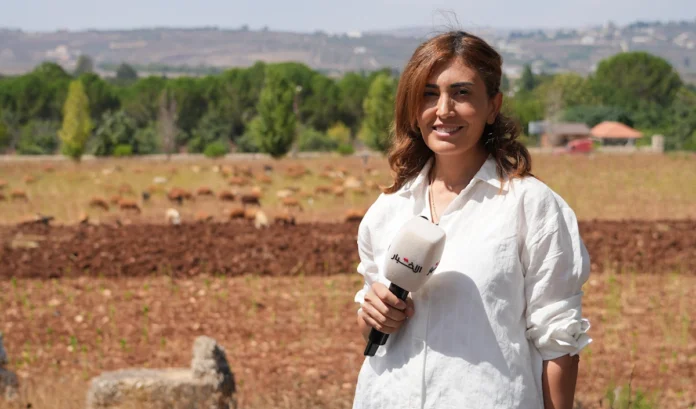
The National Human Rights Commission, which includes the Committee for the Prevention of Torture, stated that the criminal investigation and documentation of the crime committed by the Israeli occupation—resulting in the killing of journalist Amal Khalil, the mukhtar of the town of Bint Jbeil, Ali Nabil Bazzi, and citizen Mohammad Ayman Hourani, and the injury of journalist Zeinab Faraj in the southern town of Al-Tiri—has reached a preliminary conclusion that the Israeli airstrikes were deliberate, and that the decision to carry them out was made despite the occupation forces being certain that the two journalists were engaged in media coverage.
The Commission added that the preliminary investigation settles the debate regarding the civilian nature of the targets of the three airstrikes carried out by the occupation forces over several hours, despite repeated distress calls that were met with gunfire, and the prevention of rescue and search teams from reaching the targeted location until late at night.
The Commission extended its deepest condolences to the families of the victims and their colleagues, noting that the repeated threats received by Khalil, documented by UNESCO, along with the mockery and bullying practiced by the Arabic-language spokesperson of the Israeli army, constituted a prelude to justifying the assassination. The Commission considered that this reflects a systematic pattern practiced by the occupation forces against journalists to justify targeting them, which constitutes a continuation of a policy of genocide pursued by the Israeli occupation, affecting hundreds of journalists in Palestine and Lebanon under similar pretexts.
Field data and the testimony of four journalists and a paramedic within rescue teams who spoke with the Commission indicate that the two journalists were directly pursued by drones belonging to the Israeli army while carrying out their professional duty of covering field events in border areas. The attack began with the targeting of a civilian vehicle in front of them at around 2:30 p.m. yesterday, Wednesday, which led to the killing of Bazzi and Hourani. The assaults then escalated in a gradual and deliberate manner for more than two hours: the journalists’ vehicle was targeted and disabled, followed by the bombing of the place where they had taken shelter inside a house at around 4:30 p.m., resulting in serious injuries to photographer Zeinab Faraj and the loss of contact with journalist Amal Khalil for several hours, before she was found under the rubble of the house destroyed by the strike at approximately 11:15 p.m.
Field data and testimonies from paramedics and colleagues confirm that this attack was not incidental, but rather the result of deliberate targeting and direct pursuit. More than one consecutive strike was carried out at the same location, and ambulance teams were prevented from reaching the site in a timely manner by obstructing coordination mechanisms, before permission to enter was granted only after the attack had been completed.
The Commission considers that these acts, if proven, may amount to a fully-fledged war crime, as they involve the deliberate targeting of civilians, including journalists protected under international humanitarian law, in addition to obstructing relief efforts and preventing assistance to the wounded. This constitutes a grave violation of the Geneva Conventions and their customary rules, particularly the principles of distinction and humanity.
The Commission also spoke with two forensic doctors from the Nabatieh district, who stated that they had not been asked to conduct any examinations of the bodies to determine the location and nature of injuries or to identify the type of weapon used. The first doctor explained that throughout the period of the aggression, judicial authorities do not request forensic examinations, and reports are finalized without any criminal medical documentation, except in cases involving foreign nationals, whose bodies must be repatriated and thus require an official forensic report. The second doctor noted that forensic medical examinations remain limited to killings classified as ordinary crimes, while no such examinations are conducted in cases of killings resulting from operations carried out by the Israeli army.
The Commission believes that this shortcoming constitutes a serious flaw in the criminal justice system and a violation of the state’s duty to conduct effective investigations into killings, in accordance with international human rights standards—particularly regarding the right to life and the obligation to ensure accountability and prevent impunity. This situation also undermines the ability to collect and preserve forensic evidence, weakens the documentation of serious violations that may amount to war crimes or crimes against humanity, and limits the capacity of national authorities to prosecute those responsible or support any international judicial processes.
The Commission recommends the urgent adoption of measures to compel the competent judicial authorities to conduct forensic medical examinations in all cases of death resulting from acts of violence, including those related to armed conflicts, and to ensure the proper documentation of injuries in accordance with recognized scientific standards. This includes determining the nature of the injury, its trajectory, and the type of weapon used whenever possible, in addition to preserving evidence in a manner that ensures the integrity of the chain of custody, in preparation for its use in any national or international judicial proceedings.
What journalist Amal Khalil was subjected to cannot be separated from a long record of previous targeting that affected her personally and her colleagues over the past years, due to her professional work on the front lines in southern Lebanon. She had previously survived direct assassination attempts, including the targeting of her family home during the 2024 war. This attack also falls within a broader pattern of repeated violations systematically targeting journalists with the aim of intimidating them and preventing them from reporting the truth.
The Commission recalls that journalists enjoy full protection as civilians under the 1949 Geneva Conventions and the customary rules of international humanitarian law, and that deliberately targeting them, launching attacks against them while performing their work, or obstructing their medical evacuation constitutes a grave violation that may amount to a war crime requiring international criminal accountability.
The Commission notes that this crime occurs within the context of a documented pattern of attacks against journalists in Lebanon, including direct killings, injuries, threats, the targeting of media institutions, and the use of drones and live ammunition, with little to no accountability, thereby reinforcing a climate of complete impunity.
In light of the seriousness of these facts, the Commission renews its call on the Lebanese authorities to take urgent and effective steps as follows:
The National Human Rights Commission calls for urgent action to ensure accountability for the targeting of journalists in Al-Tiri.
First – The Council of Ministers:
The Commission recommends calling for an emergency session of the Council of Ministers to adopt a clear decision to hold the perpetrators of these crimes accountable. This includes mandating the Ministry of Foreign Affairs and Emigrants to take the necessary steps to accede to the Rome Statute of the International Criminal Court, or at a minimum to submit a declaration under Article 12(3) accepting the Court’s jurisdiction over crimes committed on Lebanese territory. The Commission also recommends supporting a draft resolution before the Human Rights Council to establish an independent international commission of inquiry on Lebanon, ensuring the documentation of violations, the identification of individual responsibilities, and laying the groundwork for an effective path toward international accountability.
Second – The Ministry of Justice and the Public Prosecutor’s Offices (including the Court of Cassation and Military):
The Commission recommends immediate measures to address the serious shortcomings in forensic practices by issuing binding circulars requiring forensic medical examinations in all cases of death resulting from acts of violence, including those related to armed conflicts, and not limiting them to ordinary crimes. It also calls for strengthening the role of public prosecutors, particularly those at the Court of Cassation and military level, in opening serious and independent investigations and ensuring the documentation of forensic evidence in line with international standards, in a manner that preserves victims’ rights and enhances the prospects of prosecution at both national and international levels.
Third – The Ministry of Information:
The Commission recommends that the Ministry of Information adopt a clear and public position supporting recourse to the International Criminal Court as a primary mechanism for holding perpetrators of crimes against journalists accountable, thereby limiting impunity. It also stresses the need not to limit action to referring complaints to international organizations such as UNESCO or the Security Council, given their limited effectiveness in achieving real accountability, and instead to pursue binding international judicial avenues.
Fourth – At the international level:
The Commission emphasizes the necessity of full cooperation with international justice mechanisms, particularly the proposed international commission of inquiry, and ensuring the establishment of a central evidence repository under the Office of the United Nations High Commissioner for Human Rights, in order to safeguard evidence and make it available for use in future judicial proceedings.
The Commission stresses that these measures collectively represent the minimum required to confront the climate of impunity, ensure the protection of journalists, safeguard the right to life, and uphold the rule of law.
هذه المقالة متاحة أيضًا بـ:
 العربية (Arabic)
  Français (French)

