
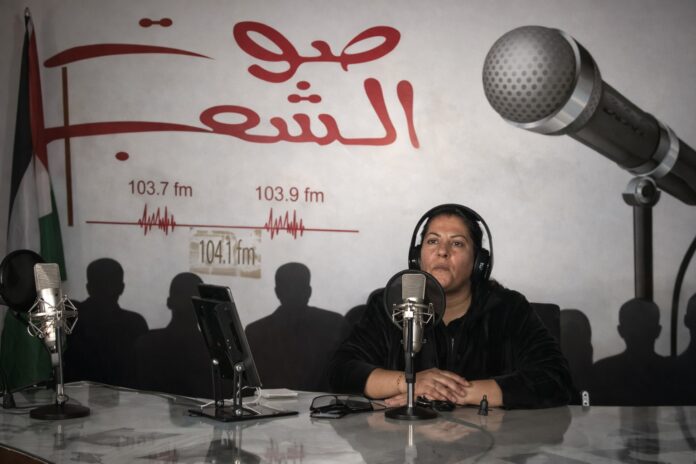
In the context of ongoing media engagement with developments in Lebanon, particularly amid the escalating violations associated with the armed conflict, the program Maakon on Sawt Al-Shaab Radio, in collaboration with Awan platform and Journalists for Human Rights, hosted the Commissioner for International Relations and Media at the National Human Rights Commission, Bassam Al-Kantar, in a live intervention from Geneva.
The discussion addressed the Commission’s role, its priorities, and the challenges it faces at the current stage. The episode was prepared and presented by journalist Faten Hamoui on 2 April 2026.
The Role of the National Human Rights Commission in the Context of the Aggression
Question: What can be said about the role of the National Human Rights Commission at this stage?
Answer:
Al-Kantar explained that the current moment, despite its severity, is one of the most critical in highlighting the importance of the role entrusted to the National Human Rights Commission under Law No. 62/2016. By virtue of its legal mandate, the Commission is responsible for monitoring the armed conflict and documenting violations committed in its context, whether those affecting civilians, infrastructure, or the most vulnerable groups.
He noted that the Commission operates under highly complex conditions, where limited resources intersect with the expanding scale and accelerating pace of violations. Nevertheless, it continues to carry out its duties by maximizing available capacities and coordinating with various national actors, including official institutions, international organizations, and research bodies. This coordination enables the development of a reliable and coherent database on violations.
He further emphasized that the Commission’s role goes beyond mere monitoring. It extends to producing well-documented legal knowledge that can later be used in accountability processes, both at the national and international levels.
Documentation as a Fundamental Entry Point to Justice
Question: What is the importance of documentation in light of the ongoing violations?
Answer:
Al-Kantar stressed that documentation is not merely a technical process, but a fundamentally human rights act that restores the dignity of victims and prevents reducing them to mere numbers and statistics. Victims, he noted, are individuals with names, stories, and families, and it is the responsibility of human rights work to preserve this human memory as an integral part of the pursuit of justice.
He explained that professional documentation requires rigorous standards, beginning with the collection of field evidence and extending to its analysis and legal contextualization. This includes identifying the types of weapons used, including prohibited weapons, documenting serial numbers, manufacturing sources, launch and impact sites, and the number of victims. It also encompasses documenting long-term harm, such as unexploded ordnance and its impact on civilians and the environment.
He further highlighted the importance of using advanced tools, including satellite imagery analysis, verification of circulated videos, and consultation with weapons experts and digital forensic specialists. These methods ensure the production of accurate findings that can be relied upon legally. He emphasized that this level of documentation is what ultimately enables the transformation of facts into evidence admissible before judicial bodies.
Monitoring the Situation of Detainees in the Context of Conflict
Question: What are the issues the Commission is currently working on
Answer:
Al-Kantar explained that the Commission is placing particular focus on the situation of detainees, especially in light of the forced displacement affecting multiple regions, which has led to the transfer of a number of detainees to other detention facilities. This monitoring includes ensuring respect for detainees’ fundamental rights, including the right to communicate with their families, access legal representation, and obtain adequate healthcare.
He noted that the Commission is working in coordination with a network of lawyers to follow up on cases of detainees who meet the conditions for release under Article 108 of the Code of Criminal Procedure. This effort contributes to reducing overcrowding and improving detention conditions.
He also emphasized the importance of paying particular attention to the most vulnerable groups within detention facilities, especially women, who face additional challenges related to conditions of detention and access to family and legal support.
Assessing the Government’s Response to the Displacement Crisis
Question: How do you assess the State’s response to the displacement crisis?
Answer:
Al-Kantar pointed out that the government’s response is marked by a clear duality, where significant efforts made by the relevant authorities are undermined by serious gaps in coordination and preparedness. He explained that the multiplicity of actors involved, combined with the absence of clear mechanisms for the distribution of roles, leads to overlapping responsibilities, which negatively affects the overall effectiveness of the response.
He further noted that international standards related to the management of internal displacement, particularly those concerning the protection of the fundamental rights of displaced persons, are not being fully respected. This, he emphasized, calls for a comprehensive review of the current operational frameworks.
He concluded by stressing that the Commission is systematically documenting these gaps, with the aim of producing analytical reports that can later inform public policy development and help prevent the recurrence of similar shortcomings in future crises.
Protection of the Most Vulnerable Groups
Question: What are the main risks facing the most vulnerable groups?
Answer:
Al-Kantar emphasized that armed conflicts exacerbate the vulnerability of certain groups, including women, children, persons with disabilities, and the elderly, which necessitates the adoption of tailored protection measures that respond to their specific needs.
He pointed to documented cases involving violations of privacy, exploitation, and a lack of respect for human dignity in some shelters. These include instances where individuals were photographed without their consent or where their suffering was used for promotional or media purposes.
He stressed the importance of adhering to the principle of “informed consent,” ensuring that any use of images or personal data is based on explicit permission, with a clear explanation of its purpose. This, he noted, is essential to preserving human dignity and preventing exploitation.
Volunteering and Supporting the Work of the Commission
Question: Is there a need for volunteers, and how can people contribute?
Answer:
Al-Kantar called on all those willing to contribute to engage in the Commission’s efforts, whether in legal documentation, monitoring the situation of detainees, or supporting groups affected by the conflict. He emphasized that human rights work requires broad societal solidarity, and that volunteers play a key role in strengthening the Commission’s capacities.
He also noted that interested individuals can get involved by reaching out via the hotline 03/923456 as an entry point to participate in these efforts.
Al-Kantar concluded his intervention by reaffirming that the National Human Rights Commission operates within a framework of complementarity with various stakeholders, with its primary objective being the protection of human rights and the preservation of victims’ dignity. He stressed that independent and professional documentation remains the most critical tool in confronting impunity and in building a long, yet necessary, path toward justice.
“Justice may be delayed, but the existence of documented truth is what makes it possible.”
هذه المقالة متاحة أيضًا بـ:

