
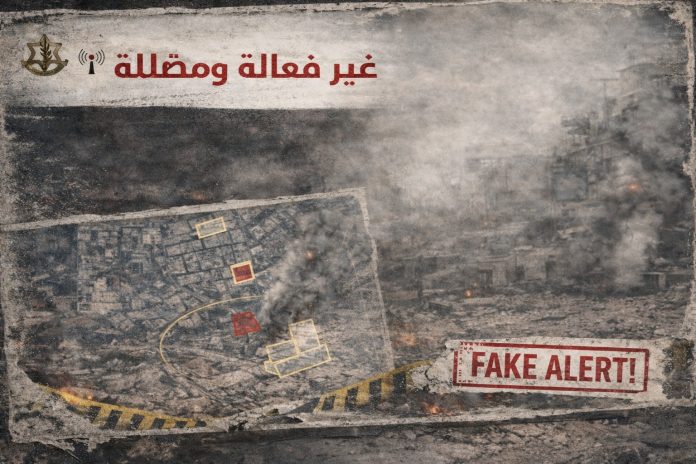
The National Human Rights Commission, which includes the Committee for the Prevention of Torture, stated today that the warnings issued by the Israeli military forces and directed at residents of the southern suburbs of Beirut and areas of southern Lebanon contain information suspected to be inaccurate or misleading. The accompanying details, including maps, lack the minimum level of adequacy and clarity to enable civilians to take appropriate protective measures, and may amount to prohibited forced displacement.
The Commission emphasized that issuing such warnings does not in any way absolve Israel of its legal obligations under international humanitarian law, particularly the duty to distinguish between civilians and military objectives, the absolute prohibition on targeting civilians, and the obligation to take all feasible precautions to avoid harm to civilians and minimize it to the greatest extent possible.
Under the provisions of international humanitarian law, parties to a conflict are required to take all feasible precautions, practically and effectively, to avoid causing harm to civilians or, at a minimum, to reduce it to the greatest extent possible when carrying out offensive operations. This obligation includes, among other things, providing effective and meaningful advance warnings to the civilian population in areas exposed to attacks, unless operational circumstances or military necessity prevent this.
Analyses conducted by monitoring teams of the International Humanitarian Law Committee within the National Human Rights Commission in Lebanon indicate that the warnings issued by Israeli forces were not limited to including misleading or inaccurate maps, but were also marked by clear deficiencies in terms of timing and method. These warnings were issued within extremely short timeframes that did not realistically allow civilians to take effective precautionary measures, with the notice period in several cases not exceeding less than fifteen minutes before the strikes began. Some were also published late at night social media platforms, in circumstances where a large number of civilians were likely asleep, offline, or not following media coverage, thereby undermining the effectiveness of these warnings and limiting their ability to achieve their intended legal purpose.
During the period between March 3 and 20, 2026, the Israeli army issued a series of evacuation orders targeting residents of entire towns and villages in southern Lebanon, in addition to areas in the Bekaa and the southern suburbs of Beirut. Among these orders, a directive issued on March 5 called on all residents living south of the Litani River and in the southern suburbs of Beirut to leave “immediately,” under the pretext of ensuring their “safety.” This was followed by another order on March 12, 2026, which expanded the scope of evacuation to include at least 17 towns and villages located between the Litani River and the Zahrani River, reflecting the widening scope of the measures taken and their collective nature.
The Commission affirmed that issuing evacuation orders covering entire towns and villages in southern Lebanon constitutes, from the perspective of international humanitarian law, a general and abstract warning lacking specificity and precision, and does not meet the effectiveness requirements necessary to enable civilians to make informed decisions بشأن their safety. This raises serious questions as to whether the objective is to create or drive conditions leading to mass forced displacement.
In all cases, the effectiveness of these warnings does not affect the continued legal protection afforded to civilians. Civilians who do not leave their areas must not be considered legitimate targets of attack. Furthermore, individuals who choose to remain in their homes, or who are unable to leave due to objective constraints—including disability, old age, or other reasons—remain fully protected under international humanitarian law, and this protection must not be violated under any circumstances.
According to the United Nations Office for the Coordination of Humanitarian Affairs (OCHA), as of March 16, Israeli evacuation orders had come to cover approximately 1,470 square kilometers, or about 14 percent of Lebanon’s total area. Many families have been forced to relocate more than once as hostilities expanded into new areas. Only around 12.5 percent (132,742 people) of the registered displaced are residing in collective shelters, while the rest rely on host families or informal arrangements.
In a number of southern villages, including Shabriha in the Tyre District, reports indicated that civil defense teams or municipalities received instructions to forcibly evacuate the remaining residents. In a notable development, it was reported that Israeli forces issued an individual evacuation order via WhatsApp, requesting a resident in Beirut to evacuate his apartment and company offices—marking the first such case reported during the current escalation.
For a warning to be effective, it must be issued in a timely manner and include clear information about safe routes and destinations to which civilians can go. The National Human Rights Commission has examined a number of these warnings and assessed the extent of their compliance with the standards set out in international humanitarian law.
The warning issued on March 12, 2026, by the spokesperson of the Israeli army, Avichay Adraee, via the platform “X,” concerning the Amroussieh area in the southern suburbs of Beirut, illustrates issues related to the requirements of effectiveness, clarity, and accuracy of advance warnings. The warning included a general directive for immediate evacuation to a distance of no less than 300 meters based on an attached map. However, it was found that the map included a building labeled “Grand Cinema ABC Verdun,” even though its location is at least 11 kilometers away from the targeted area, which caused confusion and misled residents—contrary to the requirement of clarity and precision that must be met in such warnings.
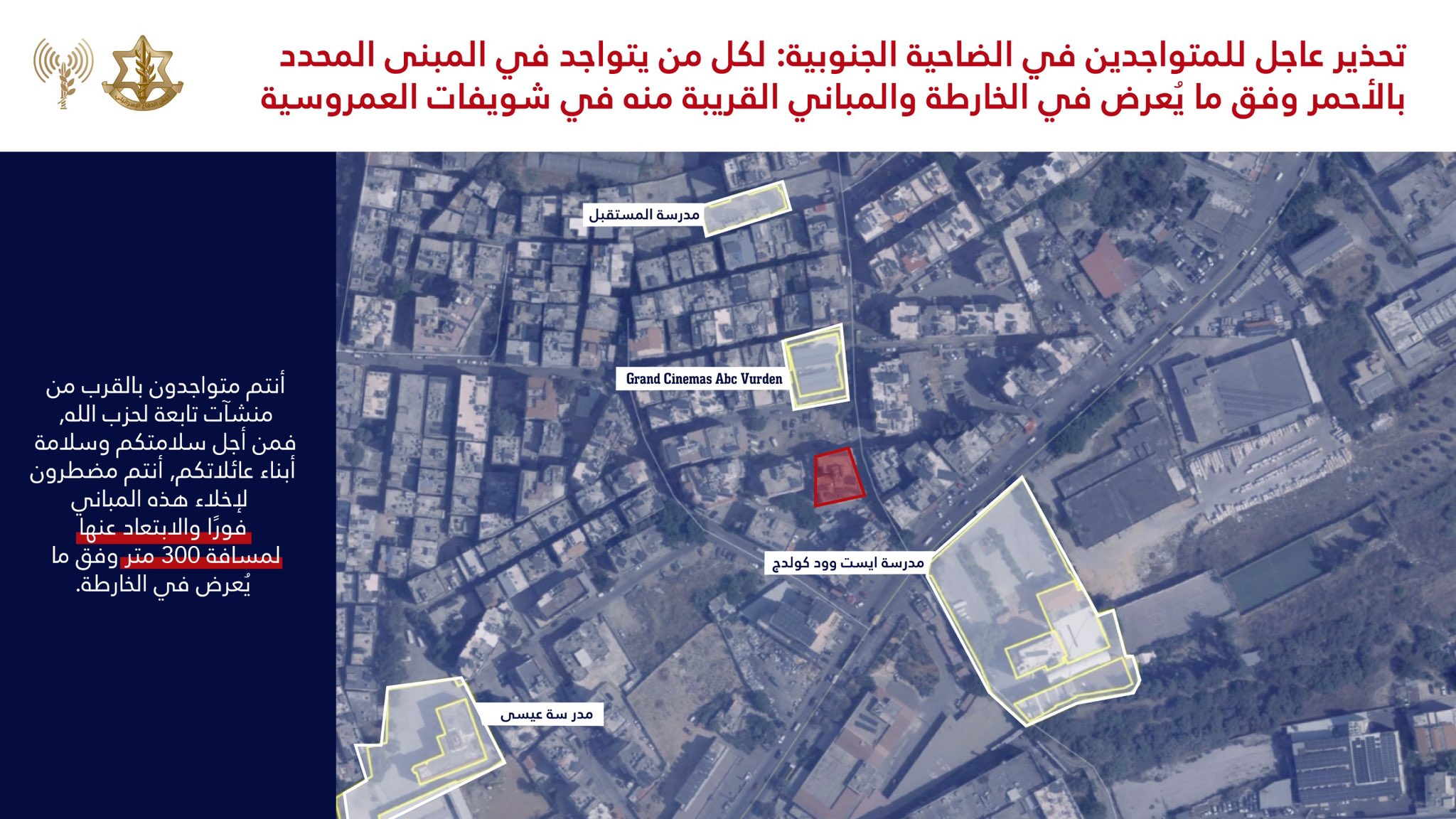
The National Human Rights Commission also found that this area had previously been subject to a similar warning in 2024 using the same map, containing the same misleading information related to the location of ABC in Verdun. This raises serious indications of a failure to update the databases used, even when they contain errors of such magnitude. This, in turn, raises serious questions about the extent to which the principle of proportionality and the obligation to take all feasible precautions to protect civilians are being respected. If the misleading or insufficient nature of these warnings is established, it may amount to a violation of the obligations incumbent upon parties to the conflict under international humanitarian law.
The repeated warnings issued to residents of the southern suburbs of Beirut—particularly those accompanied by maps published by Israeli forces—demonstrate serious legal issues in terms of accuracy, clarity, and effectiveness. These warnings covered seven different areas: Haret Hreik, Ghobeiry, Laylaki, Hadath, Burj el-Barajneh, Tahwitat al-Ghadir, and Chiyah. They were found to be misleading in nature, as they covered wide areas extending into residential zones that were not actually subjected to bombardment, particularly in Hadath, Furn El Chebbak, and Hazmieh.
It also became evident that there was a discrepancy between the administrative boundaries of the municipalities included in the Israeli army’s warning maps and the areas actually affected by threats or strikes, reflecting a flaw in accurately defining the scope of danger.
In all these cases, dozens of specific bombardment warnings issued in the southern suburbs of Beirut showed that the shaded area on the maps—intended to define the scope of immediate danger to civilians—was much smaller than the 500-meter radius that Israeli forces called on civilians to evacuate as a minimum safe distance. This contradiction between the visual representation and the required evacuation range leads to confusion among civilians and undermines their ability to make informed decisions about their safety. It raises serious questions about whether these warnings comply with the requirements of clarity, accuracy, and effectiveness, and may amount to a failure to fulfill the obligation to take necessary precautions to protect civilians under international humanitarian law.
Article 57 of Additional Protocol I to the 1977 Geneva Conventions, paragraph 2(c), stipulates the obligation to: “give effective advance warning of attacks which may affect the civilian population, unless circumstances do not permit.” It follows from this provision that the standard of effectiveness is not merely formal; rather, it requires that the warning be clear, specific, and actionable, enabling civilians to take realistic measures to avoid harm. Accordingly, warnings that are vague, overly general, or that call for the evacuation of broad areas without precisely defining the scope of danger or providing practical guidance fail to meet the requirements of this article. Such warnings lose the condition of effectiveness explicitly required and may expose civilians to additional risks or lead to unjustified forced displacement, thereby constituting a breach of the obligation to take precautions to protect the civilian population.
The Guiding Principles on Internal Displacement, particularly Principle 5, state that: “in all circumstances, authorities and international actors shall comply with their obligations under international law, including international human rights law and international humanitarian law, to prevent and avoid conditions that might lead to displacement of persons.” In this context, the wide geographical scope of Israeli warnings in Lebanon, and their coverage of extensive areas, raises serious concerns about their compatibility with this principle—especially if such warnings effectively drive populations toward mass displacement without adequate safety guarantees or suitable alternatives. The issuance of broad warnings lacking specificity and precision may contribute to creating coercive conditions that compel civilians to leave their homes, which contradicts the legal obligation to prevent and avoid forced displacement and calls for an assessment of the extent to which these measures comply with relevant international standards.
هذه المقالة متاحة أيضًا بـ:

