

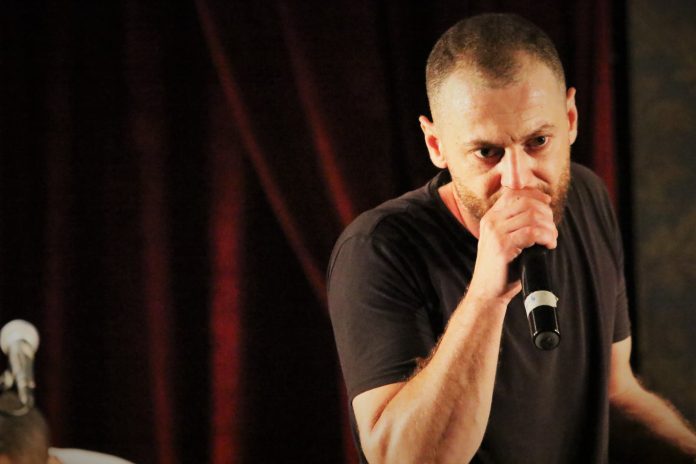
The National Human Rights Commission in Lebanon, including the Committee for the Prevention of Torture, stated that Lebanese rapper Jaafar Iskandar (38), known as Jaafar Al-Taffar, who has been detained by Lebanese Army Intelligence at the Ministry of Defense in Yarze for four days, should be released.
Jaafar Iskandar is known for publishing rap songs in video format on social media platforms addressing social and political issues in a critical tone. His most recent song included critical remarks directed at both the President of the Republic and the Prime Minister.
The Commission explained that Iskandar had voluntarily surrendered to Army Intelligence on 10 March 2026 after receiving a phone call requesting that he appear at the intelligence office in Doha Al-Hoss for questioning, according to information provided by his father, Mohsen Ahmad Iskandar, to the Commission’s investigator assigned to follow the case.
The National Human Rights Commission stated:
“The Military Public Prosecutor’s Office should refrain from using the Penal Code, the Publications Law, and the Military Justice Law to arrest journalists, artists, or any individual exercising their constitutionally guaranteed right to freedom of opinion and expression. Such investigations should remain exclusively within the jurisdiction of the Public Prosecutor at the Court of Cassation, without any interference from the military judiciary or the military institution.”
According to information provided by the family, Iskandar received a phone call yesterday at 4:00 p.m. from Army Intelligence at the Doha Al-Hoss center requesting that he appear at the center the same day, without being informed of the reasons or whether any complaint or investigation request had been filed by either the Public Prosecutor at the Court of Cassation or the Military Prosecutor. In response, he went to the center at 5:00 p.m. When his father contacted the authorities today to inquire about the reasons for his detention, he was told that the matter was pending a decision by the military judiciary.
His lawyer, one of the attorneys cooperating with the Commission, stated that he was transferred yesterday from the Army Intelligence branch in Doha Al-Hoss to the Intelligence Directorate at the Ministry of Defense. Attorney Abdel Fattah noted that her client informed her that he had been interrogated in Doha Al-Hoss before being transferred to the Ministry of Defense without the presence of a lawyer, which constitutes a violation of Article 47 of the Lebanese Code of Criminal Procedure. This article guarantees the right of a suspect to have a lawyer present during the preliminary investigation, and a suspect cannot be interrogated without a lawyer if they request one. The lawyer also has the right to review the investigation record. These provisions guarantee the right to defense, prohibit torture, and ensure fair-trial guarantees, including the right to contact family members.
She also indicated that he was questioned again in her presence at the Intelligence Directorate at the Ministry of Defense regarding the publication of a video containing a poem criticizing the President of the Republic and the Prime Minister. His mobile phone was confiscated and searched and is currently undergoing technical examination by investigators. He remains detained pending a decision by the Government Commissioner at the Military Court on whether he will be released or remain in detention.
The Commission considers that the use of the military institution to pursue critics of political officials represents an unjustified expansion of its powers to investigate civilians, and constitutes a concerning regression in the protection and promotion of human rights and public freedoms. It therefore called for the immediate release of Iskandar and the cessation of any measures restricting his exercise of fundamental rights.
The Commission has previously stated in its reports that laws imposing criminal penalties for defamation and insult in Lebanon are inconsistent with the country’s obligations under international human rights law, and are frequently used by authorities or influential actors to harass and intimidate individuals who exercise their right to criticism.
Under international human rights law, insult is not recognized as an internationally defined crime, and imprisonment is not considered an appropriate penalty for defamation offenses. Civil compensation is regarded as the most balanced remedy for harm to reputation while preserving freedom of expression.
International human rights law also clarifies that public figures, including heads of state and government, are legitimately subject to criticism and political opposition. Public officials are expected to tolerate a greater degree of criticism due to the public interest in holding them accountable.
General Comment No. 34 of the Human Rights Committee, interpreting Article 19 of the International Covenant on Civil and Political Rights, affirms states’ obligations to guarantee freedom of opinion and expression, including the right to seek, receive, and impart information and ideas regardless of frontiers. This right includes political discourse, commentary on public affairs, discussion of human rights issues, and cultural and artistic expression.
The protection of this right extends to all forms of expression and means of dissemination, including spoken and written language, images, artistic works, audio-visual media, as well as digital and electronic forms of expression on the internet.
هذه المقالة متاحة أيضًا بـ:
 العربية (Arabic)
  Français (French)

