
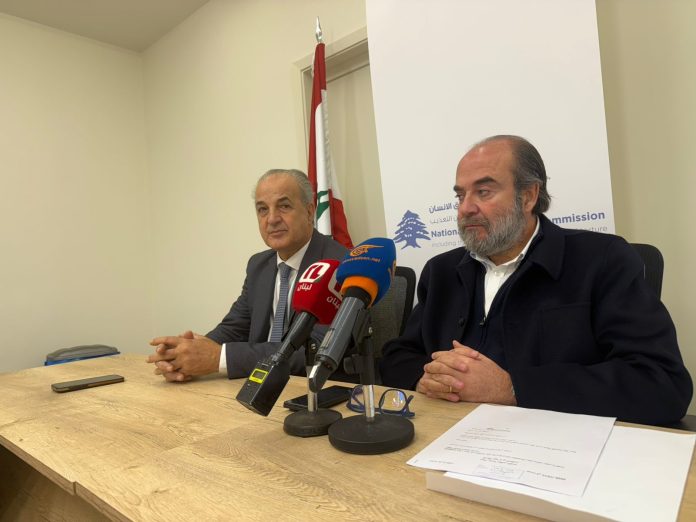
MP Georges Okais held a press conference to announce the question directed to the government regarding the regulatory decrees of the National Human Rights Commission, which includes the Committee for the Prevention of Torture. The event took place at the official headquarters of the Commission, located in the Sarhal Building, First Floor, Sami El Solh Boulevard, on Wednesday, December 17, 2025, at twelve noon.
At the beginning of the conference, Dr. Fadi Jreissati, President of the National Human Rights Commission, including the Committee for the Prevention of Torture, welcomed the media to the Commission’s new official headquarters. He thanked MP Georges Okais for his parliamentary initiative and appreciated his insistence on announcing the question from the Commission’s headquarters, recognizing the symbolic significance of this gesture in supporting the Commission’s independence and role.
MP George Okais stated:
“We congratulate the opening of the new headquarters of the National Human Rights Commission, including the Committee for the Prevention of Torture. We express deep astonishment—shared by all Lebanese—and raise a legitimate question: How can a country that was a founding partner and member of the United Nations, and whose prominent statesman Charles Malik was one of the drafters of the Universal Declaration of Human Rights in 1945, witness such a deterioration in the state of human rights?
Since 2016, the Lebanese Parliament approved the establishment of the National Human Rights Commission, including the Committee for the Prevention of Torture. Since then, the Lebanese state, through its various institutions, has failed to fulfill its duties in protecting, supporting, and empowering this Commission.
According to the law, the Commission is administratively and financially independent, with full autonomy from any ministry or oversight, in line with the international conventions Lebanon has joined. These conventions stress the importance of ensuring the Commission’s independence from the state and the executive branch to guarantee its neutrality, objectivity, transparency, and ability to receive complaints and report human rights violations.
When we hear about the state of prisons in Lebanon today and see their condition, we realize the scale of the disaster. The dignity of detainees and prisoners is directly threatened. Inmates die due to inadequate healthcare, poor nutrition, and catastrophic environmental conditions in detention centers.
The situation has reached a critical low point, while the state remains indifferent. When we ask the government, the answer is always: there is no funding. Yet, funding is readily available for many less important matters than human rights, while this fundamental right, enshrined in the Lebanese Constitution and current laws, is neglected.
Therefore, I have submitted a question to the Lebanese government through the Speaker of Parliament regarding the delay in issuing the financial allocation decree for the Chair, Vice-Chair, and members of the National Human Rights Commission. The amounts proposed or accepted by the Ministry of Finance as allocations for the Commission are, frankly, laughable and absurd.
A member of the National Human Rights Commission is part of one of the highest authorities that should exist in any state that respects its people and upholds human dignity. These allocations must reflect the significance and value of this noble function.
We ask such members to be competent and experienced—whether lawyers, journalists, doctors, or human rights activists—and we demand full-time commitment from them. Yet we tell them their monthly compensation won’t exceed $200. It’s as if we are saying: don’t apply, this Commission means nothing, it’s just decorative—established by the state merely to appease the UN.
What I’m demanding—and the purpose of this question—is that the salaries and allocations of the Commission’s leadership and members be benchmarked against those of judges, first-tier university professors, or members of the Constitutional Council. In my view, this Commission is no less important than the judiciary—it complements it.
Thus, the stance of the Ministry of Finance is regrettable and shocking. It seems the Ministry—and behind it, the government—fails to grasp the importance of the Commission’s work and its pioneering role in protecting human dignity and monitoring all human rights violations, wherever they occur.
This Commission has the authority to receive and investigate complaints, to dispatch delegates and lawyers to inspect detention centers and prisons, and to handle issues related to human rights, the rights of marginalized groups, women’s rights, children’s rights, and prisoners’ rights.
Hence, I appeal—on behalf of MPs active in the field of human rights, and on behalf of the Commission’s leadership and members—for the Lebanese government to treat this Commission as an actual official body and provide the necessary conditions for it to thrive in the human rights domain. Let Lebanon reclaim its former leading role, before the war, as a beacon of democracy, human rights, freedom, and the defense of human dignity.
We await a response from the Prime Minister and the government that ensures fair compensation, preserves the dignity of the Commission’s members, and motivates them to fulfill their role. If the response is not satisfactory, we will hold consultations to escalate this question into an official interrogation, because we will not allow the issue of human rights to be marginalized or subjected to unjust financial restrictions.”
هذه المقالة متاحة أيضًا بـ:

