

UN experts* today condemned Israel’s illegal aggression and indiscriminate bombing campaign against Lebanon on 8 April, only hours after a ceasefire agreement was brokered by Pakistan between the United States and Iran.
“We are witnessing the continuing utmost contempt for the international legal order, for diplomacy, and above all for the lives of civilians and the environment in Lebanon,” the independent experts said. “Israel has chosen the very moment a ceasefire was announced – one that its Pakistani mediator stated included Lebanon – to unleash the largest coordinated wave of strikes on the country since 1980.”
“This is not self-defence. It is a blatant violation of the UN Charter, a deliberate destruction of prospects for peace, and an affront to multilateralism and the UN-based international order,” they said.
The experts were concerned that despite the recent announcement of a ceasefire between the United States and the Islamic Republic of Iran, prospects for wider regional de‑escalation remain uncertain. The lack of tangible progress on talks last weekend underscored the fragility of existing ceasefire efforts and urgency of stepping up diplomatic engagement.
“The United States’ imposition of a naval blockade is an act of war that has further destabilised the situation,” the experts warned.
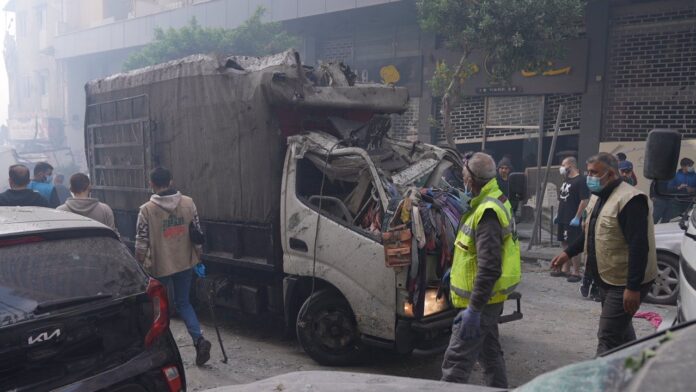
Since the cessation of hostilities between Lebanon and Israel on 27 November 2024, Israel has repeatedly violated Lebanon’s sovereignty. In a 10-minute onslaught on 8 April 2026, Israeli forces struck more than 150 locations simultaneously across Lebanon, killing at least 303 persons, and wounding 1,150 others. Hundreds remain under the rubble. Many strikes hit densely populated residential neighbourhoods and commercial areas in central Beirut in violation of the principles of distinction and proportionality and the obligation to take all feasible precautions under customary international humanitarian law (IHL). The strikes caused severe environmental damage by releasing toxic air pollutants and greenhouse gas emissions, contaminating water systems, and destroying ecosystems through fires, debris, and chemical residues.
According to the Government of Lebanon, since 2 March, the Israeli army has killed more than 2,000 people in Lebanon, including health workers and journalists, and injured 6,588 others. Over 1 million people have been displaced amounting to approximately one in five of Lebanon’s population, of which an estimated 140,682 are in overcrowded shelters. Already in March 2026, the experts raised alarm over a rapidly escalating displacement crisis in Lebanon, after intense Israeli airstrikes and evacuation warnings in southern Lebanon and parts of Beirut. The pace of displacement in this phase of the conflict has been described by the United Nations High Commissioner for Refugees as faster than during the 2024 escalation. Thousands of civilians — among them women, children, the elderly, and persons with disabilities — have been compelled to abandon their homes.
“The issuance of blanket evacuation orders, combined with the destruction of urban and village housing that displaced persons would have returned to, is consistent with the pattern of domicide that was initiated during the genocide in Gaza,” the experts warned. “The deliberate destruction of homes is a weapon of war and a form of collective punishment, particularly in Shiite areas in the rural South of the country. It also points to ethnic cleansing.”
“Forced displacement of a civilian population constitutes crimes against humanity and is a war crime under international law,” they said.
The experts also condemned Hezbollah’s recent cross-border attacks against Israeli civilians and urged it to abide by the 2024 ceasefire deal, pursuant to Security Council resolution 1701.
The experts urgently called for:
- Israel to immediately cease all military operations in Lebanon, comply with the ceasefire framework and Security Council Resolution 1701, withdraw its forces, enable the safe return of displaced persons, and engage in direct negotiations with Lebanon.
- The United States to use its influence to ensure Israel halts strikes on Lebanese civilians and infrastructure without delay.
- All Member States to suspend arms transfers to Israel while there is credible evidence of serious violations of international humanitarian and human rights law.
- The international community to support Lebanon’s humanitarian response, including funding the USD 308 million Flash Appeal.
*The experts:
- George Katrougalos, Independent expert on the promotion of a democratic and equitable international order;
- Ben Saul, Special Rapporteur on the promotion and protection of human rights and fundamental freedoms while countering terrorism;
- Paula Gaviria Betancur, Special Rapporteur on the human rights of internally displaced persons
- Farida Shaheed, the Special Rapporteur on the right to education
- Claudia Mahler, Independent Expert on the enjoyment of all human rights by older persons
- Balakrishnan Rajagopal, Special Rapporteur on adequate housing as a component of the right to an adequate standard of living, and on the right to non-discrimination in this context
- Morris Tidball-Binz, Special Rapporteur on extrajudicial, summary or arbitrary executions
- Nicolas Levrat, Special Rapporteur on minority issues
- Astrid Puentes Riaño, Special Rapporteur on the human right to a clean, healthy and sustainable environment
- Claudia Flores (Chair), Ivana Krstić (Vice-Chair), Dorothy Estrada Tanck, Haina Lu, and Laura Nyirinkindi, Working Group on discrimination against women and girls
- Gina Romero, Special Rapporteur on the rights to freedom of peaceful assembly and of association
- Mai Sato, Special Rapporteur on the situation of human rights in the Islamic Republic of Iran
- Francesca Albanese, Special Rapporteur on the situation of human rights in the Palestinian territory occupied since 1967
- Reem Alsalem, Special Rapporteur on violence against women and girls, its causes and consequences
- Siobhán Mullally, Special Rapporteur on trafficking in persons, especially women and children
- Elisa Morgera, Special Rapporteur on the promotion and protection of human rights in the context of climate change
- Surya Deva, Special Rapporteur on the right to development
- Attiya Waris, Independent Expert on foreign debt, other international financial obligations of States on the full enjoyment of all human rights, particularly economic, social and cultural rights
- Mariana Katzarova, Special Rapporteur on the situation of human rights in the Russian Federation
- Michael Fakhri, Special Rapporteur on the right to food
Special Rapporteurs/Independent Experts/Working Groups are independent human rights experts appointed by the United Nations Human Rights Council. Together, these experts are referred to as the Special Procedures of the Human Rights Council. Special Procedures experts work on a voluntary basis; they are not UN staff and do not receive a salary for their work. While the UN Human Rights office acts as the secretariat for Special Procedures, the experts serve in their individual capacity and are independent from any government or organization, including OHCHR and the UN. Any views or opinions presented are solely those of the author and do not necessarily represent those of the UN or OHCHR.
هذه المقالة متاحة أيضًا بـ:
 العربية (Arabic)
  Français (French)

