

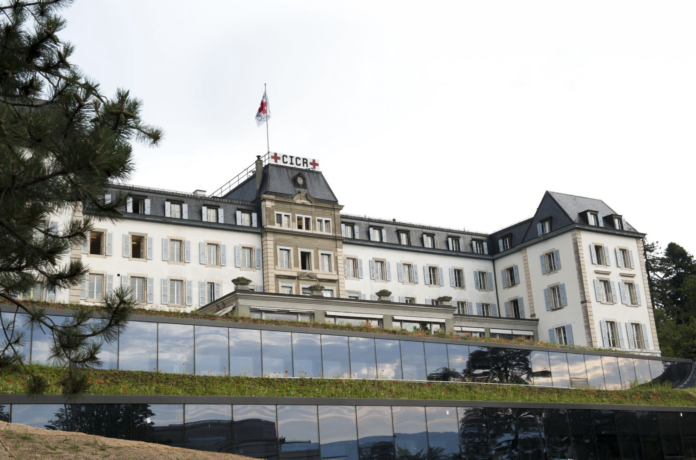
A delegation from Lebanon’s National Human Rights Commission, including the Committee for the Prevention of Torture (NHRC-CPT), held a meeting with teams from the International Committee of the Red Cross (ICRC) at its headquarters in Geneva, on the margins of the Global Alliance of National Human Rights Institutions (GANHRI) Annual Assembly.
The NHRC delegation included Dr. Fadi Gerges, President of the Commission, and Mr. Bassam Al Kantar, Commissioner for International Relations. They met with ICRC representatives, including Dr. Paola Forgione, Legal Adviser, along with members of the working groups involved in the Global Initiative to Renew Political Commitment to International Humanitarian Law (IHL), launched jointly by the ICRC and Brazil, China, France, Jordan, Kazakhstan, and South Africa.
This two-year initiative aims to develop concrete and actionable recommendations to strengthen respect for IHL and adapt it to contemporary challenges, culminating in a high-level global meeting on respect for the principle of humanity in war by the end of 2026.
During the meeting, participants reaffirmed the core objectives of the initiative:
, Elevating IHL as a political priority at global, regional, and national levels,
, Refocusing international discussions on raising expectations for parties to conflicts to ensure consistent and faithful implementation of IHL,
, Addressing key challenges related to the prevention of violations and the conduct of hostilities through clear and practical recommendations.
Participants emphasized that the Geneva Conventions, which protect victims of armed conflict, embody the shared conscience of humanity and universal values that transcend borders and beliefs. Since their adoption in 1949, they have helped protect millions of lives and uphold human dignity. However, the ongoing suffering witnessed in armed conflicts worldwide reflects persistent failures to respect and comply with their fundamental rules.
The discussions stressed that the international community bears a collective responsibility to ensure compliance with IHL, strengthen accountability for violations, and alleviate human suffering, particularly as conflicts intensify and their human, political, social, and economic costs escalate. The need for urgent action was highlighted, including reinforcing the protection of civilians, civilian infrastructure, healthcare services and personnel, and humanitarian workers.
Within this framework, the ICRC presented the operational approach of the initiative, including the establishment of dedicated working groups engaging in broad consultations with States and experts to develop practical recommendations addressing both current and emerging challenges, leading to the 2026 global meeting.
The NHRC delegation presented a detailed overview of its framework for monitoring and documenting IHL violations, through its specialized International Humanitarian Law Committee established under its internal regulations. The presentation outlined the Commission’s mandate and methodologies, including evidence-based approaches, the “do no harm” principle, source protection, and rigorous standards of accuracy and impartiality.
The meeting also featured an in-depth exchange of expertise on methodologies and legal standards, including best practices in evidence collection, digital documentation, data analysis, and legal qualification of violations, in line with international standards applicable in complex conflict settings.
Both parties explored opportunities for technical cooperation and sustained dialogue, including capacity-building initiatives, development of operational tools, and coordination with relevant international frameworks, notably the ICRC and Geneva Academy guidelines on investigating IHL violations.
In this context, the ICRC discussed the NHRC report entitled “Challenges to the Rule of Law and Respect for Human Rights during the Israeli War on Lebanon.” The NHRC underscored the importance of the work carried out by its International Humanitarian Law (IHL) Committee, noting that its methodologies are aligned with international standards, in particular the reference framework on criminal investigations, including Standard 5.2, which pertains to the effectiveness, independence, and impartiality of investigations.
At the conclusion of the meeting, both sides underscored the importance of strengthening cooperation between national human rights institutions and international actors to enhance monitoring mechanisms, promote accountability, and support efforts to protect civilians and ensure respect for IHL.
They also reiterated the call for all High Contracting Parties to the Geneva Conventions to join the global initiative and reinforce sustained political will to respect and implement IHL, with the shared objective of reducing human suffering and guiding armed conflicts toward peaceful resolution.
This meeting reflects NHRC’s continued engagement in international efforts to promote respect for IHL and to develop effective national mechanisms for monitoring violations, in line with Lebanon’s international obligations.
هذه المقالة متاحة أيضًا بـ:
 العربية (Arabic)
  Français (French)

