
In times of armed conflict, the protection of human dignity and the preservation of the rule of law depend not only on the existence of legal norms, but on their effective implementation. Among the most critical tools to ensure compliance with international humanitarian law (IHL) is the conduct of credible, independent, and effective investigations into alleged violations.
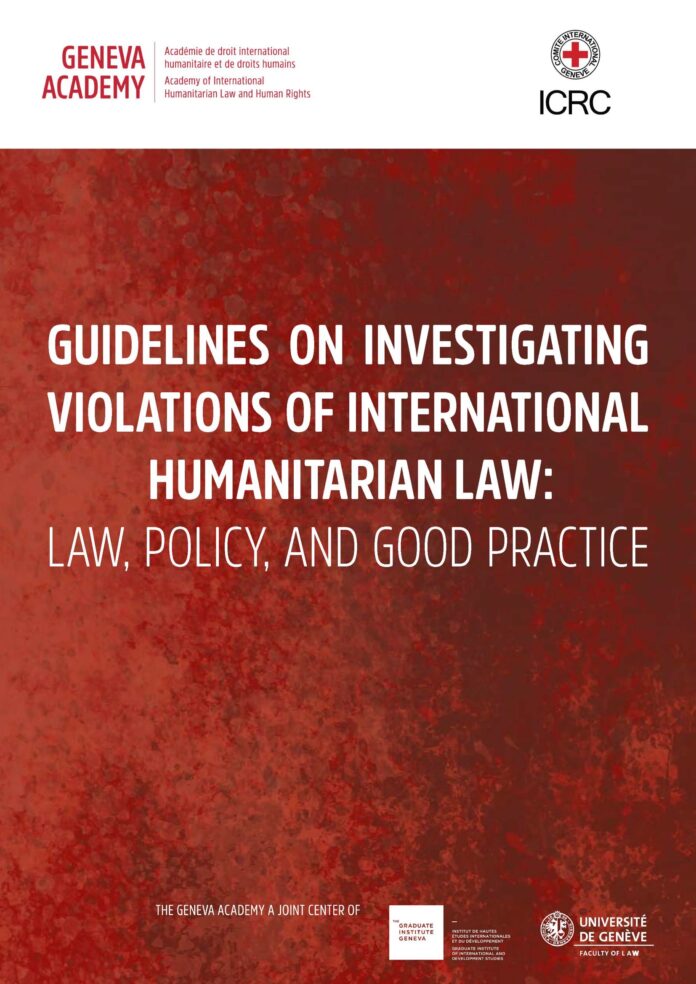
The Guidelines on Investigating Violations of International Humanitarian Law: Law, Policy, and Good Practice provide a comprehensive framework to support States and relevant actors in fulfilling this obligation. They offer not a rigid template, but a set of principles, standards, and operational steps designed to guide investigations in diverse legal and operational contexts.
The importance of investigations in armed conflict is rooted in both legal and practical considerations. From a legal perspective, States are obligated under the Geneva Conventions and customary international law to investigate serious violations, particularly war crimes, and to prosecute those responsible where appropriate. This obligation reflects a broader commitment to ensure respect for international humanitarian law and to prevent impunity. Investigations are also required under other branches of international law, including international human rights law and international criminal law, where they serve as a necessary component of accountability and justice. At the same time, investigations fulfill critical non-legal functions. They strengthen military discipline, enhance operational effectiveness, and contribute to institutional learning by identifying failures and areas for improvement. They also play a crucial role in maintaining public trust and demonstrating a State’s commitment to transparency and legality, particularly in contexts where allegations of violations may be contested or politicized.
Central to the Guidelines is the concept of an “effective investigation,” which is understood as an investigation capable of establishing the facts surrounding an incident, identifying both individual and systemic responsibility, and enabling appropriate remedial action. While the term “effective” does not have a single fixed definition, it is shaped by a set of widely recognized principles that have emerged across international legal frameworks. These include independence and impartiality, which require that investigations be free from undue influence and conducted without bias; thoroughness, which demands a comprehensive examination of all relevant evidence and circumstances; promptness, which ensures that investigations are initiated and carried out without unnecessary delay; and transparency, which promotes accountability and public confidence while taking into account operational constraints. These principles are complemented by the requirement that investigations be conducted in good faith, using all feasible means available in the circumstances, even in the challenging conditions of armed conflict.
The Guidelines place significant emphasis on the early stages of the investigative process, often referred to as the “triggering process,” which are critical to the overall effectiveness of any investigation. This process begins with the systematic recording of military operations, a continuous activity that involves the collection, documentation, and retention of information related to operational decisions, actions, and outcomes. Recording is not limited to incidents that raise immediate concerns, but encompasses all relevant aspects of military activity, including the use of force, civilian harm, detention operations, and the application of rules of engagement. By ensuring that accurate and timely records are maintained, this process creates a foundation upon which investigations can later rely to reconstruct events and assess compliance with legal standards.
When an incident occurs, immediate actions at the scene become essential to preserving evidence and ensuring that critical information is not lost. Commanders present at the scene may be required, within the limits of feasibility, to secure the area, document the circumstances through photographs or other means, identify potential witnesses and victims, and collect initial statements. These steps are particularly important in the context of armed conflict, where conditions may rapidly deteriorate and access to the scene may become restricted. The Guidelines recognize that such responsibilities must be balanced with operational priorities, but they stress that even basic measures to preserve evidence can significantly influence the outcome of subsequent investigations.
The next stage in the process involves the prompt reporting of incidents through the appropriate chain of command. Reporting serves to bring incidents to the attention of competent authorities and is a key mechanism for triggering further action. The obligation to report may arise in various situations, including cases where there is a clear suspicion of a war crime, where the circumstances suggest that a violation may have occurred, or where certain operational events, such as the capture or detention of individuals, require documentation for legal and operational reasons. Effective reporting systems ensure that information flows efficiently within military and institutional structures, enabling timely assessment and decision-making.
Following reporting, an assessment is conducted to determine whether an investigation is required and, if so, what type of investigation should be initiated. This assessment involves evaluating the credibility of the information available, the nature and severity of the alleged conduct, and the existence of sufficient factual basis to proceed. The outcome of this process may lead to the initiation of a criminal investigation, an administrative inquiry, or, in some cases, a decision that no further action is necessary. The assessment stage is not always linear and may involve multiple actors and layers of decision-making, reflecting the complexity of institutional processes in both military and civilian contexts.
The Guidelines distinguish between criminal and administrative investigations, each serving distinct but complementary purposes. Criminal investigations are aimed at establishing individual criminal responsibility for conduct that constitutes a violation of international humanitarian law, particularly war crimes. These investigations are essential for fulfilling the obligation to prosecute and punish serious violations and are typically conducted within the framework of domestic criminal law. Administrative investigations, on the other hand, focus on non-criminal violations or broader systemic issues that may have contributed to an incident. They are intended to identify operational shortcomings, policy failures, or disciplinary breaches, and to recommend corrective measures that can prevent recurrence. In practice, both types of investigations may be conducted in parallel or sequentially, depending on the circumstances.
A notable strength of the Guidelines lies in their recognition that violations of international humanitarian law are not always the result of isolated individual acts, but may reflect deeper systemic or policy-related issues. These may include deficiencies in training, inadequate rules of engagement, failures in command and control, or structural weaknesses within military institutions. Investigating such issues requires a broader analytical approach that goes beyond individual accountability and seeks to address the underlying causes of violations. In this context, the concept of State responsibility becomes particularly relevant, as States are obligated not only to cease violations and provide reparations, but also to take measures to prevent their recurrence.
The role of commanders is central to the effective implementation of these obligations. Commanders bear responsibility for ensuring that their subordinates are aware of and comply with international humanitarian law, and they are required to prevent, suppress, and report violations where they occur. This responsibility extends to taking appropriate disciplinary or criminal action when necessary, and failure to do so may itself give rise to liability. The Guidelines underscore the importance of leadership and accountability within military hierarchies, highlighting the need for clear procedures, adequate training, and a culture of compliance.
At the same time, the Guidelines acknowledge the practical challenges inherent in conducting investigations in armed conflict. These challenges include limited access to incident sites, the destruction or loss of evidence, the displacement of witnesses, and the constraints imposed by ongoing hostilities. The concept of feasibility is therefore introduced as a key consideration, referring to what is practicable under the circumstances while taking into account both humanitarian and military considerations. Importantly, feasibility must be applied in good faith and cannot be used to justify the absence of an investigation altogether. Even in difficult conditions, certain investigative steps should always be possible and must be pursued to the extent feasible.
Strengthening domestic investigative mechanisms is a central objective of the Guidelines. Effective national systems not only enhance accountability and reinforce the rule of law, but also reduce the need for external interventions by international or regional bodies. They contribute to the principle of complementarity under international criminal law, whereby States retain primary responsibility for investigating and prosecuting violations within their jurisdiction. By developing robust and credible investigative processes, States can demonstrate their commitment to fulfilling their international obligations and to ensuring justice for victims.
Ultimately, the investigation of violations of international humanitarian law is not an end in itself, but a means to achieve broader goals. It is a tool for accountability, a mechanism for learning and reform, and a foundation for justice and reconciliation. In the absence of effective investigations, violations risk going unaddressed, undermining both the protection of civilians and the integrity of the legal framework governing armed conflict. The Guidelines serve as a reminder that even in the most challenging circumstances, the pursuit of truth and accountability remains essential. Upholding these principles is not only a legal duty, but a moral imperative that lies at the heart of efforts to protect human dignity and maintain the rule of law in times of war.
هذه المقالة متاحة أيضًا بـ:

