

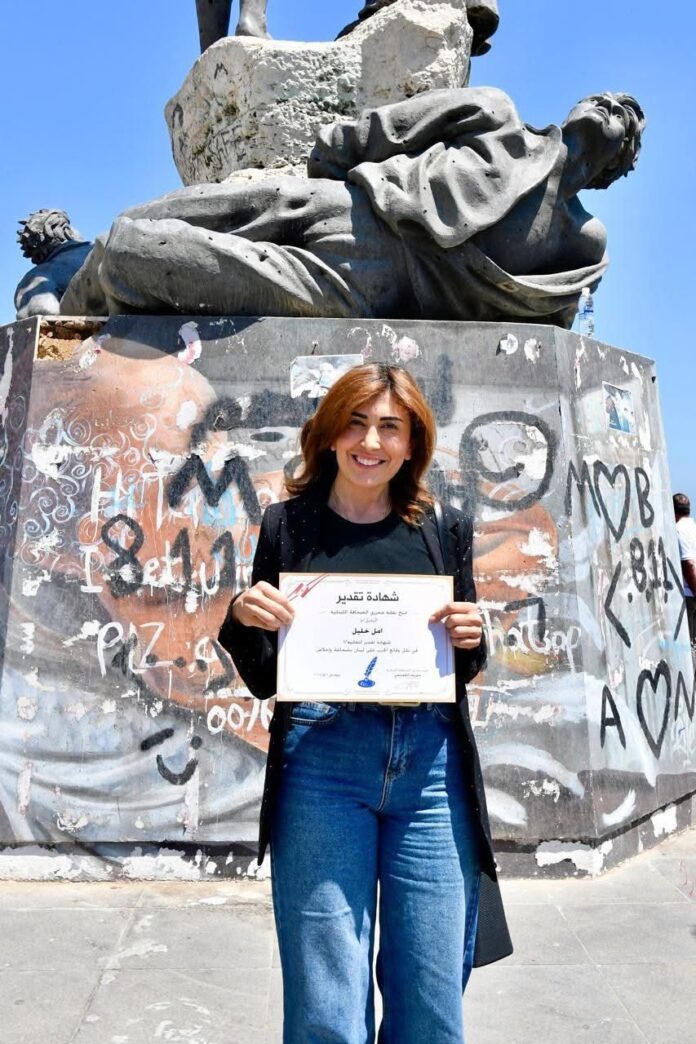
The National Human Rights Commission is closely monitoring, with deep concern, the media content—both local and international—relating to the killing of journalist Amal Khalil. It notes that parts of this coverage have been characterized by ambiguous narratives that lack the professional accuracy and legal rigor required when addressing incidents of such gravity. The Commission reaffirms that targeting journalists while carrying out their work constitutes, under international humanitarian law, a serious violation that may amount to a war crime. It further observes that some media treatments have not only failed in their duty to report facts accurately, but have also contributed to diverting attention from the core of the crime and obscuring the clarity of the legal responsibility arising from it.
A preliminary review of this content indicates that certain coverage has deviated from professional standards, whether by using headlines and framing that shift focus from the act of targeting to the identity of the victim, or by introducing political labels and general classifications unrelated to the act itself, thereby undermining her status as a civilian journalist entitled to protection. Some reporting has also tended to present competing narratives in a superficial manner, without subjecting them to verification or legal assessment. This approach effectively dilutes the truth under the guise of “balance,” even though incidents involving the targeting of civilians, particularly journalists, do not permit such false neutrality that empties the crime of its legal meaning. In addition, some reports have failed to fully present the facts or have omitted the context of the victim’s journalistic work, while also lacking any clear call for solidarity or for ensuring immediate access to medical and rescue assistance, despite the evident danger and obstruction of relief efforts.
The Commission considers that this type of discourse does not fall within the protected scope of freedom of expression. Rather, it may directly or indirectly contribute to creating a justificatory environment that weakens accountability and opens the door to impunity, particularly when narratives from parties to the conflict are relayed without scrutiny or without being assessed against applicable professional and legal standards. Presenting unverified accounts or giving them equal weight to established facts risks entrenching a narrative that justifies violence against journalists and weakens the protection afforded to them under international humanitarian law as civilians. Furthermore, obstructing access to emergency assistance for the wounded or those trapped constitutes an additional violation that must be clearly highlighted, not overlooked or minimized.
In this context, the Commission stresses that respect for the principle of distinction and the protection of civilians, including journalists, is a binding legal obligation, and that any breach of these rules requires precise legal characterization without equivocation or mitigation. It also emphasizes that any media discourse that seeks to justify such acts or downplay their seriousness represents a departure from professional standards and may amount to indirect incitement or contribute to the perpetuation of violations.
Accordingly, the Commission calls on all media outlets to adhere strictly to the principles of accurate and independent journalism, to refrain from classifications or descriptions that may undermine the legal protection of victims, and to adopt clear terminology that reflects violations in line with international humanitarian law. It further underscores the importance of promoting media discourse that places the protection of journalists at its core, contributes to uncovering the truth, and reinforces accountability, rather than creating superficial balances that ultimately serve to justify the crime.
The killing of journalist Amal Khalil is not a passing incident within the context of conflict, but a grave event that demands responsible media and legal engagement, rejecting any attempt to reshape the facts in a way that diminishes the seriousness of the violation or obscures its nature. The Commission affirms that protecting journalism is inseparable from protecting the truth, and that any drift in media discourse toward justification or doubt undermines the foundations of justice and contributes to the entrenchment of impunity.
هذه المقالة متاحة أيضًا بـ:
 العربية (Arabic)
  Français (French)

