
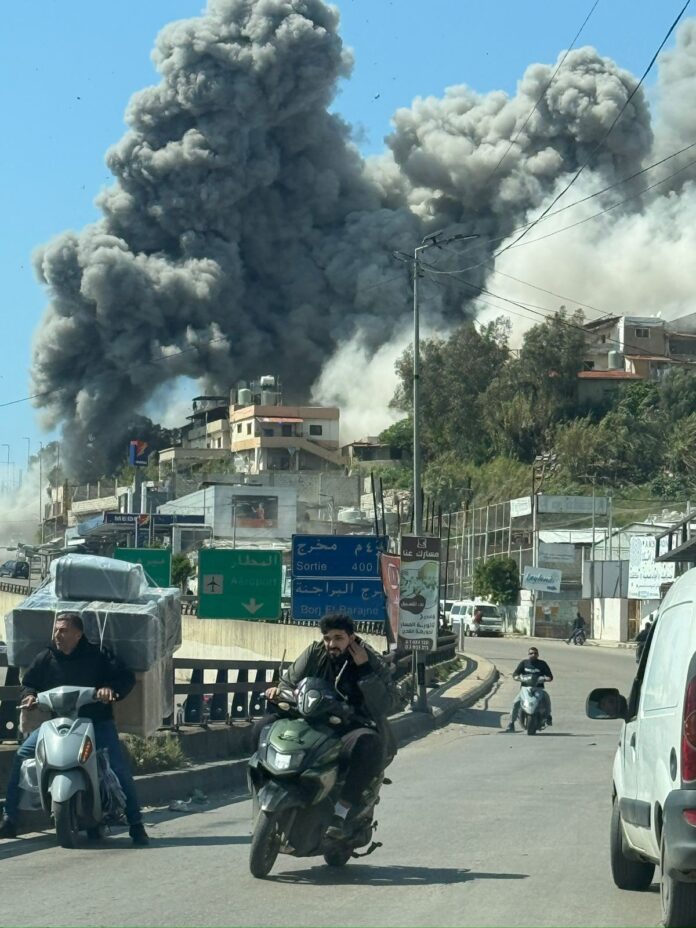
The International Humanitarian Law Committee of the National Human Rights Commission – Lebanon expresses its deep concern regarding the large-scale, coordinated wave of airstrikes reportedly carried out by the Israel Forces across multiple regions of Lebanon, including Beirut, the southern suburbs, the Bekaa Valley, Mount Lebanon, and southern Lebanon.
According to available information, these strikes were conducted within a very short timeframe and targeted more than one hundred locations simultaneously. The scope, intensity, and geographic spread of these attacks raise serious concerns regarding the protection of civilians and compliance with international humanitarian law.
Field documentation collected and reviewed by the Committee indicates that the strikes affected a wide range of areas including densely populated urban neighborhoods in Beirut and its southern suburbs such as Bir Hassan, Hayy al-Sellom, Corniche al-Mazraa, Msaytbeh, Basta, Ain al-Tineh, and Choueifat, in addition to surrounding areas including Aramoun, Keyfoun, and Bchamoun. Reports further indicate direct strikes on residential buildings, including apartments, which heightens concerns regarding civilian casualties and damage to civilian property.
In southern Lebanon, strikes were reported across numerous localities, including Bint Jbeil, Harouf, Jbaa, Ain Qana, Zefta, Sour, Saida, Sarafand, Deir al-Zahrani, Ansar, and others, reflecting a wide geographic distribution that suggests a pattern of repeated and dispersed attacks across entire districts. Additional strikes were documented in the Bekaa and Baalbek-Hermel regions, including Douris, Shmistar, Hermel, and surrounding areas, further expanding the scope of hostilities.
The Committee recalls that all parties to an armed conflict are bound by the rules of international humanitarian law, including those reflected in the Additional Protocol I to the Geneva Conventions and customary international law. These rules impose clear and non-derogable obligations, notably the principles of distinction, proportionality, and precaution.
The principle of distinction requires parties to distinguish at all times between civilians and combatants, and between civilian objects and military objectives. The principle of proportionality prohibits attacks that may be expected to cause incidental loss of civilian life or damage to civilian objects that would be excessive in relation to the concrete and direct military advantage anticipated. The obligation of precaution requires all feasible measures to be taken to verify targets and to minimize harm to civilians, including through the issuance of effective advance warnings where circumstances permit.
The Committee emphasizes that the scale and simultaneity of the reported strikes raise serious questions as to whether these obligations could be effectively implemented across such a wide range of targets within such a compressed timeframe. The use of explosive weapons with wide-area effects in densely populated areas significantly increases the risk of indiscriminate harm and may result in unlawful attacks.
The Committee further notes claims that military objectives were located within civilian areas. In this regard, it recalls that the presence of fighters or military infrastructure in populated areas does not deprive civilians of their protection under international humanitarian law, nor does it render entire neighborhoods legitimate military targets. All feasible precautions must remain in place, and obligations under international law continue to apply fully.
The reported pattern of strikes also raises concerns regarding the cumulative humanitarian impact on the civilian population. Damage to residential buildings and essential infrastructure risks disrupting access to basic services, including electricity, water, healthcare, and food supply chains, at a time when Lebanon is already facing severe economic and social challenges.
The International Humanitarian Law Committee underscores that intentionally directing attacks against civilians or civilian objects, as well as launching indiscriminate or disproportionate attacks, may constitute war crimes under international law. Ensuring accountability for such violations is a fundamental requirement of the international legal order.
In light of the above, the Committee calls on all parties to the conflict to:
- Strictly adhere to the rules of international humanitarian law, including the principles of distinction, proportionality, and precaution
- Refrain from launching attacks that may place civilians and civilian objects at risk
- Ensure that effective warnings are issued in a manner that allows civilians to seek safety
- Facilitate humanitarian access and protect essential civilian infrastructure
- Take all necessary measures to prevent further escalation and civilian harm
The National Human Rights Commission, will continue to monitor developments closely, document potential violations, and engage with national and international stakeholders to uphold the protection of human rights and the rule of law.
هذه المقالة متاحة أيضًا بـ:

