

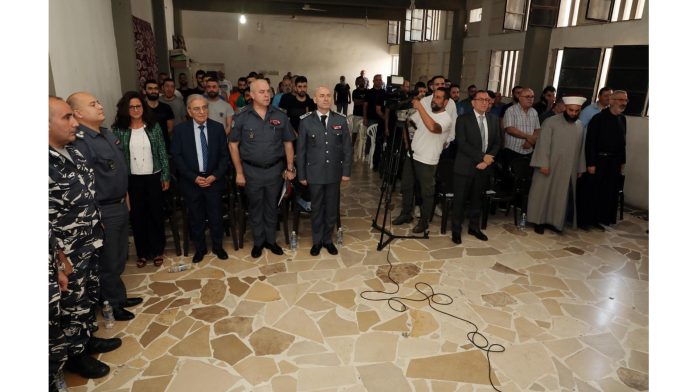
The National Committee for the Prevention of Torture participated in a ceremony held at Roumieh Central Prison, Sentenced Prisoners’ Building, marking the graduation of a new group of inmates who successfully completed a literacy and English language course. The programme represents the fifth cycle of such training and was organized by the Evangelical Prison Fellowship in coordination with the Internal Security Forces.
The ceremony was held under the patronage of the Director General of the Internal Security Forces, Major General Raed Abdallah, represented by Brigadier General Joseph Msalem, Head of the Public Relations Division. The event was attended by several judicial, religious, and administrative figures, including Judge Dr Khalil Bou Rjeily, President of the National Committee for the Prevention of Torture, as well as representatives of the Higher National Committee for Prisons, the Evangelical Prison Fellowship, and a number of security officers.
During the ceremony, 43 inmates received certificates after completing the educational programme, which aims to strengthen inmates’ basic education and language skills and to support their social reintegration after the completion of their sentences. Speeches delivered by Brigadier General Msalem, Reverend Antoine Skaff, and Reverend Fred Lahoud emphasized the importance of educational programmes in prisons and their role in supporting inmates psychologically, culturally, and socially, while encouraging them to rebuild their lives positively.
The Committee for the Prevention of Torture emphasized that such educational and rehabilitative initiatives are an essential component of modern correctional policies that place human dignity, rehabilitation, and reintegration at the center of prison management. The Committee also noted that improving detention conditions and providing educational opportunities contributes to reducing tensions within places of detention and enhances prospects for rehabilitation.
In this context, the Committee recalled the recommendations it had previously submitted to the Lebanese Parliament as part of a roadmap aimed at reducing overcrowding in prisons and detention facilities, including amendments to the Law on the Replacement of Certain Sentences with Community Service (Law No. 138/2019), as well as amendments to the Penal Code and the Code of Criminal Procedure to reduce excessive reliance on detention.
The Committee also called on the judiciary to review the use of pre-trial detention, stressing that it should remain an exceptional measure used only when strictly necessary, given its direct impact on prison overcrowding.
Furthermore, the Committee reiterated the importance of adopting legislation allowing the use of electronic monitoring bracelets as an alternative to pre-trial detention, and of ensuring the necessary resources for its implementation once adopted. It also emphasized the need to accelerate judicial proceedings and ensure that detainees are brought to court hearings on time, as this would contribute to reducing overcrowding in detention facilities and improving the administration of justice.
The ceremony concluded with the distribution of certificates to the graduating inmates, highlighting the importance of cooperation between public institutions and civil society initiatives in supporting rehabilitation programmes within prisons and promoting the successful reintegration of inmates into society.
هذه المقالة متاحة أيضًا بـ:
 العربية (Arabic)
  Français (French)

