
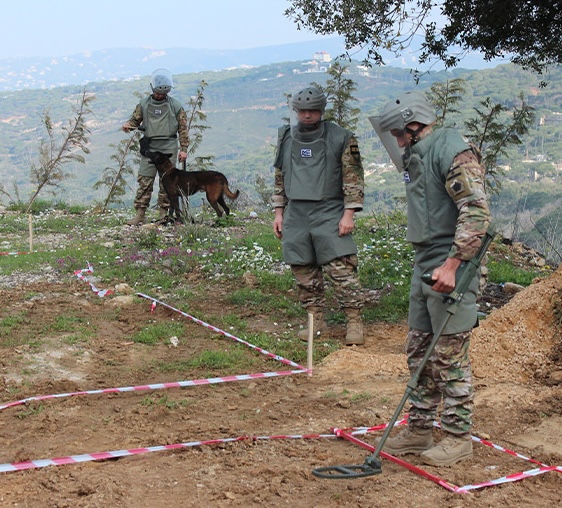
The National Human Rights Commission, including the Committee for the Prevention of Torture (NHRC-CPT), welcomes Decree No. 2281 dated 12 January 2026, issued by the Lebanese Council of Ministers, approving Lebanon’s accession to the Convention on the Prohibition of the Use, Stockpiling, Production, and Transfer of Anti-Personnel Mines and on Their Destruction. The Commission considers this decree a fundamental national step that strengthens Lebanon’s commitment to international humanitarian law and the protection of civilians from the consequences of armed conflicts.
The Commission views this decision as a pivotal milestone in enhancing public safety and reducing the persistent risks that continue to threaten the lives of citizens, particularly in areas affected by remnants of war, where landmines and unexploded ordnance still claim lives and hinder sustainable development.
This decision reflects the Government of Lebanon’s commitment to humanitarian mine action and its respect for and adherence to international humanitarian law. It also comes in the context of Lebanon’s accession to key international instruments, including the Convention on Cluster Munitions (ratified in 2010), the Convention on Certain Conventional Weapons, Protocol II (ratified in 2017), and the Convention on the Rights of Persons with Disabilities (ratified in 2025), demonstrating Lebanon’s continued support for international disarmament and human rights efforts.
The Commission recalls that it has, in several of its previous reports, recommended and encouraged the Lebanese authorities to accede to the Anti-Personnel Mine Ban Convention. It considers the issuance of this decree a positive response to these recommendations and reaffirms its determination to continue advocating for the swift ratification of the Convention by Parliament at the earliest possible opportunity.
The Commission further affirms that its International Humanitarian Law Committee will closely follow up on the implementation of this commitment. The Committee works to ensure respect for all international humanitarian law treaties, protocols, and relevant customary rules to which Lebanon is a party, whether through ratification or accession.
In particular, the Committee undertakes, inter alia, the following functions:
-
Monitoring and documenting violations of international humanitarian law and pursuing all available means to combat impunity.
-
Providing opinions on legislative and administrative texts to ensure their alignment with international humanitarian law and related international agreements, in conformity with Lebanese legislation.
-
Developing annual action plans addressing necessary measures to promote international humanitarian law and raise awareness of its implementation mechanisms and legal requirements.
-
Submitting recommendations to relevant authorities to ensure proper application of related legislative and administrative provisions.
-
Promoting a culture of international humanitarian law in cooperation with ministries, public institutions, universities, schools, and civil society organizations.
-
Exchanging information and expertise with humanitarian organizations, international committees, and civil society actors, and strengthening relations with counterpart committees within national human rights institutions of member states of the Global Alliance of National Human Rights Institutions.
The Commission affirms that Lebanon’s accession to this Convention reflects a clear political will to adopt a comprehensive humanitarian approach to disarmament and to strengthen Lebanon’s position within the international system dedicated to protecting human dignity and the rights to life and security.
The Commission further stresses the importance of complementing this step by developing a clear national plan to implement the Convention’s obligations, strengthening the capacities of relevant institutions, in particular the Lebanese Mine Action Center, securing adequate financial and human resources for survey, clearance, and risk education activities, and ensuring support, rehabilitation, and social and economic reintegration for victims and survivors.
In this context, the Commission calls for enhanced cooperation among public authorities, civil society, and international partners to ensure the effective and sustainable implementation of the Convention and to achieve tangible results on the ground.
In conclusion, the National Human Rights Commission, including the Committee for the Prevention of Torture, reaffirms its commitment to continuing its monitoring and advisory role, accompanying the implementation of this decree, and working towards a mine-free Lebanon that is safer, more just, and respectful of human dignity and the right to life and security.
هذه المقالة متاحة أيضًا بـ:

